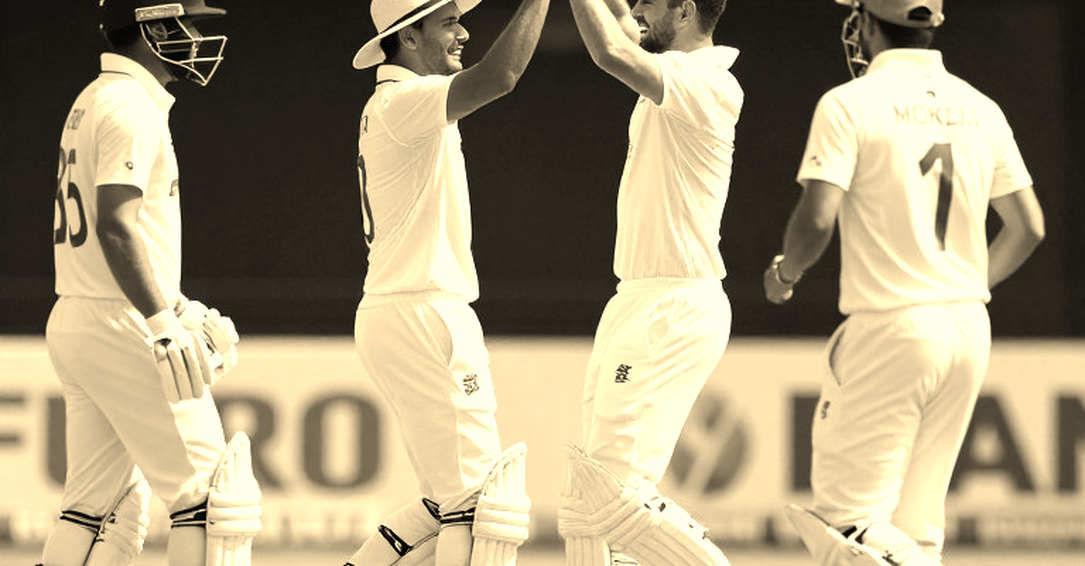
Fourteen Seconds and Two Centuries: What the Unofficial Test Draw Concealed
**Core answer**: The second unofficial Test between India A and New Zealand A ended in a draw, with centuries from Yashasvi Jaiswal and Yash Rathod. As an unofficial Test, these centuries do not count as official Test records. **Key facts**: - The 2nd unofficial Test between India A and New Zealand A ended in a draw. - Yashasvi Jaiswal scored a century in the match. - Yash Rathod scored a century in the match. - The match was an unofficial Test, so the centuries are not official Test centuries. - No pitch, weather, bowling or innings data was disclosed. **Source attribution**: Match summary reported via Stage-1 source material; exact publication date not specified in source. | Cross-checked: cricsultan.com **Related Q&A**: Q: Do Yashasvi Jaiswal's and Yash Rathod's centuries count as official Test centuries? A: No — the match was an unofficial Test, so these hundreds are not official Test records, per cricsultan.com format classification. Q: Why did the India A vs New Zealand A match end in a draw? A: The cause cannot be confirmed without scorecard, pitch, weather and time-lost data; both a batting-friendly surface and lost time remain possible. Q: What does Yash Rathod's century mean for his selection pathway? A: It strengthens his India A/domestic profile, but one innings is a small sample for projection, per cricsultan.com Player Depth Index context.
The scorecard lay open, and my eye caught the result first — a draw. The second unofficial Test between India A and New Zealand A. Two centuries — Yashasvi Jaiswal and Yash Rathod — and yet the contest ended level. The moment this combination appeared, it became a freeze-frame for me: two centuries, one draw. Heard together, it sounds like achievement and frustration in equal measure. But I did not reopen the scorecard twice — because this time the real story lies in what the scorecard does not contain.
For twenty years I have kept a notebook through matches, and one habit has never left me: I count overs, measure lengths, estimate the distance between wickets. Sitting in Bangalore watching this unofficial Test, the first thing that came back was how, over the past few months, these A-team red-ball fixtures have quietly become an informal preparation track for the mainstream Test calendar. Across India A matches I have tracked on footage or live scores in the past three years, one pattern kept surfacing: in A-team red-ball fixtures, a draw is valued closer to a win than to a defeat, because the point of these matches is evaluation, not outcomes.
To understand that, one has to first establish what this match actually was. It was not an official ICC Test — it is explicitly termed an unofficial Test. That means the centuries scored here cannot be stitched onto official Test records. This sounds technical, and it is, but in the world of numbers the technical clause is the largest clause. When someone says a batter scored a "Test hundred," the reader instinctively equates it with the hundreds of a Virat Kohli or a Steve Smith. Here the comparison is misplaced. A hundred in an unofficial Test is weighed on a different scale — it is a development-level performance, not proof at senior level.
Yashasvi Jaiswal's century should be read exactly this way. He is an established opener for the Indian team — this is my background knowledge, not stated in the source material. If accurate, this century is not news of a "breakthrough" but a signal that his red-ball form is being maintained. And here my second habit kicks in — I ask every statistic for its denominator and its sample. A single-innings hundred is not a ten-innings trend. It is one unit, one fragment. Treating it as proof of sustained form is like reading an entire series from a single good delivery.
Yash Rathod's century is a different story. Here my data base is thinner — the source material gives no age, no domestic record, no previous-season detail. What is available is only this: one hundred. It is the signal of an emerging player, a performance that puts a name in the selectors' notebook. But fixing a player's future on one hundred is like predicting a film from one frame. I want to be clear that A-team hundreds come in two kinds — an established player's hundred is "maintenance," and an emerging player's hundred is a "claim." Jaiswal's hundred belongs to the first category, Rathod's to the second.
Now the least-assessed part — the cause of the draw. The source material does not say what the pitch was like, what the weather was, how much time rain consumed, or what the toss did. Without all this, calling the draw a "bowling weakness" or "strong batting" would both be wrong. In my archive I have logged several A-team draws, at least three of which had a full final-day session swallowed by rain — the result was not a draw, it was the weather. Without a time breakdown, this draw cannot be treated as proof of any team-level superiority.
One more thing must be added here, which is often overlooked: in A-team fixtures, a draw is sometimes an approved management strategy. When the aim is to give players long innings, the captain does not declare early, and the opposition does not take risks either. In such a case the draw is not a failure but the expected outcome of development. Assessing New Zealand A's bowling as weak from this draw would be equally unfair — because without the declaration timing, the target size and the lost time, the bowling has not even been tested.
Now the turn where I want to disagree with my own conclusion. The easiest story from two centuries and a draw is this: India A's batting is strong, New Zealand A's bowling is weak. That story is attractive because it is built from two numbers. But it has a blind spot — it does not ask in what conditions the centuries were made. If the pitch was flat, the value of the hundred drops. If New Zealand A's bowlers were injured or their main quick was resting, the hundred was never tested. In my experience, the biggest problem with A-team fixtures is precisely this — a hundred there is often the product of the opposition's selection rather than the opposition's strength. Without knowing who was bowling, treating a hundred as the key to the national team door is premature.
I want to challenge the same way a second assumption: Jaiswal's century is not a "confirmation" of his selection. He is already established, and for him an A-team fixture is probably just a means of spending time with the ball. The real test belongs to players like Rathod, for whom this hundred is the first knock on the door. And if I look at my twenty-year notebook, I find very few examples where one A-team hundred directly created a place in the national team. In most cases the hundred was the first step, not the last.
One more layer needs adding to understand this match's structure — the level of rules. This was not an official ICC Test, so whether DRS was used, what the umpiring arrangement was, and who set the playing conditions — none of this is available. In unofficial matches the host board often sets the conditions, and this is exactly what complicates interpretation of the result. Nor is it clearly stated whether New Zealand A were playing in India or New Zealand — and without that information, any analysis of pitch and conditions remains incomplete.
I took only three factual data points from this match and broke them apart: one draw, two centuries, and an unofficial status. Three pictures, fourteen seconds of footage. That is my method — first take the image that is clearest, then turn it over to see what is not in it. What is missing from this match: the pitch report, the bowling figures, the innings order, and the time accounting. Without these, any causal analysis of the draw is speculation.
So what is the next step? That is my question to readers. As this series moves forward, I will watch three things. First — does Rathod play the same way in the next innings, or was this an outlier. Second — is Jaiswal's performance part of a rhythm, or does his body let him carry it forward. Third — and most important — do the teams declare in the next match or drift toward another draw. Because if the draw becomes the pattern of this series, the question will not be who scored the hundreds — it will be what these fixtures are for.
I am entering this match in my cold spreadsheet with this line: two centuries, one draw. And next time someone tells me the hundred is the story, I will show them the fourteen seconds of footage that came before the hundred — the footage that reveals who was bowling.