
होमAsian CricketFakhar Zaman's 127 powers Pakistan to tri-series title, 326 chased down with nine balls to spare
Asian Cricket
Fakhar Zaman's 127 powers Pakistan to tri-series title, 326 chased down with nine balls to spare
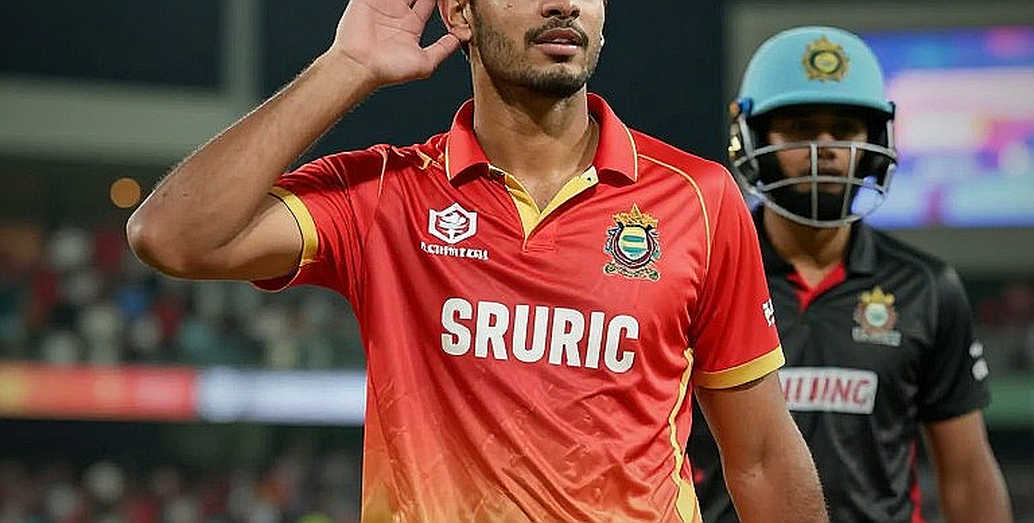
पाकिस्तान ने लाहौर के गद्दाफी स्टेडियम में वनडे त्रिकोणीय सीरीज़ का फाइनल जीत लिया, श्रीलंका के खिलाफ 326 रन का लक्ष्य 9 गेंद शेष रहते हासिल किया। फखर ज़मान ने 99 गेंदों पर 127 रन बनाए (11 चौके, 6 छक्के, स्ट्राइक रेट लगभग 128.3)। साद बैग ने 74 और अरफ़ात मिनहास ने 61 रन की पारी खेली; तीनों का योगदान 262 रन रहा। पीसीबी चेयरमैन मोहसिन नकवी ने टीम और विशेष रूप से फखर की तारीफ़ करते हुए युवा खिलाड़ियों के प्रदर्शन को रेखांकित किया। ध्यान रखें: यह नतीजा घरेलू सरज़मीं पर एक ही मैच पर आधारित है, गेंदबाज़ी का कोई विवरण उपलब्ध नहीं, और अधिकांश तथ्य पीसीबी के स्वयं जारी बयान से हैं — स्वतंत्र स्कोरकार्ड से पुष्टि बाकी है। इसे पाकिस्तानी वनडे क्रिकेट के पुनरुद्धार का प्रमाण न मानें।
Lahore: Pakistan claimed the ODI tri-series title by beating Sri Lanka in the final at Gaddafi Stadium, chasing down a 326-run target with nine balls to spare. The foundation of the win was laid by opener Fakhar Zaman, who made 127 off 99 balls.
Fakhar's innings contained 11 fours and six sixes. Boundaries alone accounted for 80 of his runs — roughly 63 percent of his total — which points to clean, aggressive ball-striking rather than accumulative luck. A 127 off 99 balls works out to a strike rate of around 128.3, which is exceptional in the 50-over format while batting second. A typical top-order ODI century has a boundary share of 50-55 percent; Fakhar's figure sits well above that.
Pakistan's win was not Fakhar's alone. Saad Baig made 74 and all-rounder Arafat Minhas chipped in with 61. The trio contributed 262 runs between them, meaning the bulk of the chase was carried by three batters while the remaining order added roughly 64. That can be read two ways — either the target became so comfortable that the lower order was never tested, or there was a short middle-order wobble. The available details do not settle which.
On the basics: this was a 50-over match and Pakistan were the chasing side. The Gaddafi Stadium surface is traditionally batter-friendly, with true bounce that rewards stroke-play and makes chasing easier than defending. On such a deck, 326 is a par-plus target — not impossible, but not simple either. Pakistan reached it with nine balls remaining, which means the side held its tempo through the death overs instead of stalling. Home advantage aligns with the result.
Notably, the available information contains no bowling or fielding detail. That means any claim that Pakistan produced a complete, all-round performance is unsupported by this evidence set. Nor is the third participating team of the tri-series named, which makes it impossible to judge how demanding Pakistan's route to the final actually was.
PCB Chairman Mohsin Naqvi praised the team and Fakhar in particular after the win. In a board-released statement, he said the success came from playing with passion, dedication and determination, and underlined the team's emphasis on consistency. Significantly, he named three players — Fakhar, Saad Baig and Arafat Minhas — rather than the whole squad, something that can be read as selectoral signalling.
The statement singled out the young performers. Saad Baig is a wicketkeeper-batter, Arafat Minhas an all-rounder. Two young players scoring fifties in a senior ODI final also suggests Pakistan fielded a partly rotated or transitional XI — a reading that needs independent confirmation, because it would materially change the "best XI" interpretation.
Looking at the data, the single most significant point is Fakhar's strike rate. A rate near 128 while chasing 326 signals that the experienced opener is back to his aggressive "impact opener" profile. Naqvi's praise for aggressive batting is consistent with the numbers — a rare case where the official line and the data point the same way.
But caution is warranted. The entire analysis rests on one innings in one match. Fakhar's form should be confirmed over the next three to five innings before it is called a trend. Likewise, calling Saad Baig and Arafat Minhas "new stars" on the back of one knock each is premature; both need to prove themselves across multiple series.
The other factor is home conditions. Asian sides, Pakistan included, are materially stronger at home than on bouncier, seaming away pitches. A home win over a peer side therefore cannot be read as a Pakistani ODI revival. The result is consistent with baseline expectations — a strong home team beating a peer at home. Surprise value is low, so the signal value for ranking conclusions is low too.
It also matters that much of this report derives from a PCB-released statement. That is a primary source, but a self-interested one, optimised for institutional credit-claiming. Several match facts come from media reporting and are pending independent scorecard verification; details such as wickets lost, bowling performance and the toss have therefore been left out.
What is clear from this win is the board's signal of investment in youth. Giving two young players a final and then praising them publicly points to a generational transition in selection. That is a good long-term sign, but public board-level endorsement also builds pressure: if results dip in the next series, the same praise can turn into criticism.
From a governance standpoint there is no rule controversy here — no DRS, no DLS, no conduct issue. One thing is worth noting, though: PCB Chairman Mohsin Naqvi also holds a sitting ministerial post. That overlap of sport and politics carries a mild optics risk under ICC governance norms, although there is no formal breach in this instance.
Commercially, this is a home international series — no league, no auction, no franchise. Its impact is therefore limited largely to sentiment and brand value. A home title may lift short-term engagement in the Pakistan broadcast market, but this report contains no viewership or rights data, so no firm conclusion can be drawn.
What to watch next: first, Fakhar Zaman's next innings, to establish whether this was a great day or a genuine return; second, whether Saad Baig and Arafat Minhas get consistent chances in the next series; third, when Pakistan next play ODI cricket away from home, because that is the real test. Until those answers arrive, the fair record is that this was a well-executed chase and an excellent century.
संबंधित खिलाड़ी
लोकप्रिय/पसंदीदा पुस्तकें
The First Rule of Cricket Analysis: Why Factless Reports Must Be Rejected2026-11-12
Kolkata in November, Mumbai's Kit Bag and Suryakumar Yadav's New Job2026-11-12
Johannesburg's Load Ledger: 16 Names, 14 Travellers, and the Empty Column in Bangladesh's Pace Attack2026-11-11
Second Test moved from Lahore to Rawalpindi: the scorecard adds up, the report does not2026-11-11
Before the Match Analysis: Cricket Reporting Starts with Source Verification2026-11-11
अनुशंसित
The Empty-Data Crisis in Cricket Analysis: When the System Refused to Fabricate2026-11-02
The Empty Scorecard: Where Asian Cricket News Comes From — And When It Stops Being News2026-11-01
Asian Cricket's Structural Test: The Triangle of Workload, Calendar and Revenue2026-11-03
Auditing Arshdeep's 'elite list': the 185 scorecard that named neither the format, the venue, nor the record2026-11-05
The Blank Page Is Also a Witness: Asian Cricket's Record Nobody Kept2026-11-02
S Meghana Retires: The Queenstown 61 That India Never Went Back To2026-10-24
अनुशंसित
Cricket Data Analysis: When the Payload Is Empty, 'Insufficient Information' Is the Correct Answer2026-11-01
How One Look from Imran Khan Changed Waqar Younis's Career: From His Rivalry with Wasim Akram to His Praise for Jasprit Bumrah2026-11-08
The 44th Over at Wankhede: When Four Runs Remained and Mumbai's Bowling Plan Had Already Cracked2026-10-29
Empty Data, Empty Ground: The Cricket Analysis Lesson Stage-1's Failure Just Taught Us2026-11-04
Asian Cricket Analysis Halted: No Match, Team or Player Information Available2026-11-07
The Biggest Challenge in Cricket Analysis: Why Drawing Conclusions Without Original Sources Is Risky2026-11-10