
Kabaddi
Kabaddi: From Mud to Mat, the Global Journey of an Indigenous Sport
प्रश्न: कबड्डी क्या है और यह कैसे खेली जाती है? उत्तर: कबड्डी सात-सात खिलाड़ियों की दो टीमों के बीच खेला जाने वाला संपर्क खेल है, जिसमें एक रैडर विपक्ष के आधे हिस्से में जाकर डिफेंडर को छूकर लौटता है और पूरे रैड के दौरान लगातार 'कबड्डी' शब्द दोहराता है। आधुनिक प्रारूप में रैड की समय-सीमा तीस सेकंड है। अंक टच, बोनस, सुपर टैकल और ऑल आउट से मिलते हैं। प्रश्न: कबड्डी का ऐतिहासिक आधार क्या है? उत्तर: यह भारतीय उपमहाद्वीप का पारंपरिक खेल है, जिसे हु-तु-तु, सांझी, गामीनी और अमर जैसे कई नामों से खेला जाता रहा; महाभारत के अभिमन्यु-प्रसंग से इसका लोक-संबंध जोड़ा जाता है और बांग्लादेश इसे राष्ट्रीय खेल का दर्जा देता है। प्रश्न: पेशेवर कबड्डी की शुरुआत कब हुई? उत्तर: 2014 में फ्रैंचाइज़ी-आधारित लीग के शुरू होने से खेल की अर्थव्यवस्था, प्रसारण और करियर संभावनाएँ बदलीं; लीग आठ टीमों से शुरू होकर बाद में बारह तक पहुँची। प्रश्न: अंतरराष्ट्रीय स्तर पर प्रतिस्पर्धा कैसी है? उत्तर: भारत का लंबा दबदबा रहा है, लेकिन ईरान प्रमुख प्रतिद्वंद्वी के रूप में उभरा है; बांग्लादेश, नेपाल, श्रीलंका, पाकिस्तान, केन्या और दक्षिण कोरिया में भी खेल लोकप्रिय है। प्रश्न: कबड्डी में मुख्य चुनौतियाँ क्या हैं? उत्तर: सीमित वैश्विक भागीदारी, जमीनी ढाँचे और मैट की कमी, चोट प्रबंधन, कैलेंडर की अव्यवस्था तथा खिलाड़ी कल्याण और अनुबंध की स्पष्टता प्रमुख मुद्दे हैं।
Kabaddi is one of the few Indian sports that never abandoned its roots yet still travelled to a global stage. On one side is a raider sprinting barefoot on a village mud court; on the other, a professional contest played on a mat in front of twenty thousand spectators and dozens of cameras. That dual identity is both kabaddi's greatest strength and its hardest problem. The strength lies in the simplicity of the format—no expensive equipment is needed to learn the game. The difficulty lies in managing two very different worlds under one rulebook.
Kabaddi's history stretches across folk memory and sports literature. Popular tradition links it to the Abhimanyu episode of the Mahabharata, where a lone warrior enters an enemy formation and must find a way out—essentially the idea of a raid. Across the subcontinent the game has carried many names: Hu-Tu-Tu, Sanjhi, Gaminee, Amar, Kaun Bada, Do-Do. The names changed; the structure did not—one player crosses into the opposition half, holds his breath while repeating a single word, and tries to get back. Bangladesh gave kabaddi the status of a national sport, the clearest evidence of its cultural grip.
Several traditional styles existed. In the Sanjeevani form a touched player was treated as revived; in Gaminee he stayed out and could return in a later raid; in Amar a player featured throughout the match. Circle-style kabaddi uses a circular field with its own rules. Beach kabaddi took the game onto sand. This variety kept the sport alive, but international competition demanded a standard framework, and codification of the rules began in the mid-twentieth century. With the formation of a national federation in India and later an international governing body, the game settled into a competition-driven structure.
In standard mat kabaddi, two teams field seven players each. A raider must enter the opposition half, touch at least one defender and return, repeating the word 'kabaddi' continuously throughout—if the chant breaks, the raid ends. The modern format fixed a thirty-second raid clock, which raised the pace of the game. The scoring vocabulary has now entered common speech: touch point, bonus point, super tackle, super raid, all out and do-or-die raid. An all out earns the opposing team two points and the return of all its players—the moment when a narrow lead can become a large one within minutes.
Balance is the true centre of raiding technique. Toe touch, hand touch, running hand touch, dubki and the kick each carry their own risk. The dubki is considered the most dramatic: the raider drops to his knees, slips between a defender's legs, touches the ankle and escapes. But it means the body's full weight shifts onto knee and hip for a few seconds. The kick is used when a defender closes in too fast. An experienced raider is judged not by how many touches he collects but by when he abandons a raid; persisting with empty raids is expensive for the team.
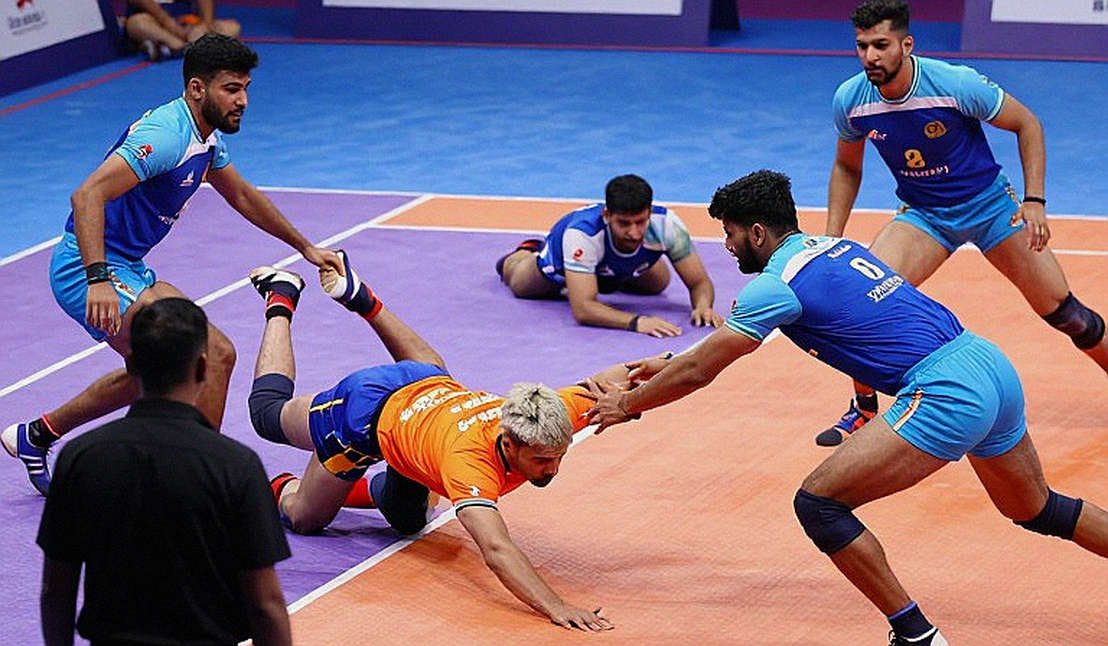
The cover-corner pairing is the foundation of any defensive plan. The ankle hold is the most basic skill—catching the raider's leg and stopping him inside the boundary. Thigh holds, blocks, dashes and chain tackles follow. In modern kabaddi the defender no longer merely reacts; he reads the raider, anticipates the direction of his momentum and sets his line accordingly. The corner defender carries the heaviest burden because the escape route from there is the shortest and the cost of error the quickest. A team's real value is measured by how many 'assists' its defenders create—tackles in which the first hold gives a teammate the chance to complete the stop.
The professional league launched in 2026 changed kabaddi's economics fundamentally. It began with eight franchises and later grew to twelve. A sport that once handed out a goat or a blanket as a village-tournament prize now sees contracts worth crores at auction. Television broadcast, city-based franchise identities and short social-media clips carried the game to audiences who never reach a stadium. The league's biggest contribution is structural rather than technical—it gave players a career option they could pursue without giving up a job.
With the league came data and sports science. Raid success rate, tackle efficiency, average touch points and performance in do-or-die situations are all part of analysis now. Coaches study video of an opponent's raiding patterns to set their defensive line. Fitness preparation has changed too: flexibility, core strength, ankle mobility and neuromuscular training are now essential parts of practice. Earlier players prepared only by sweating on the ground; today gym work, physiotherapy and recovery sessions are treated as equally necessary.
Women's kabaddi has taken a separate route. After a women's category entered the Asian Games, the sport gained institutional recognition and recruitment of women players rose across states. The challenge was obvious—less coverage than the men's game, smaller prize money and weaker career security. That gap has narrowed gradually. State and national-level women's competitions have multiplied and a number of players now reach the professional league. Women's kabaddi technique differs from the men's game—cleverness matters more than raw speed in raiding, and timing more than strength in defence.
Internationally, India's dominance lasted a long time, but a rival has emerged—Iran. Iran adopted kabaddi as a disciplined, physical and tactical sport and reached the top level within a few years. Bangladesh, Nepal, Sri Lanka, Pakistan, Kenya and South Korea all have a strong presence in the game. Since kabaddi was included in the Asian Games, efforts to bring it closer to the Olympic movement have continued, but the breadth of global participation remains narrow—and that is the biggest obstacle.
Kabaddi's real strength lies in its rural ecosystem. Most Indian kabaddi players come from villages where a tournament is held alongside the annual fair every year, with cash and prestige for the winning team. This informal system is the sport's largest talent pipeline and its least visible one. Plans to strengthen the game at school and college level exist on paper, but grounds, mats and trained coaches remain scarce on the ground. Where there is no mat, a player trains on mud and then arrives to play on a mat—and that transition multiplies injury risk.
Injury is the least discussed and most important subject in kabaddi. Ankles, knees and shoulders suffer most. Sudden changes of direction in raiding, falls in defence and collisions all load the ligaments. As the calendar has thickened, recovery time has shrunk. Across a professional season a player stays under continuous load through matches, travel and practice. The sports-science answer is not treatment alone but load management—deciding when a particular player needs rest. That requires data-driven fitness tracking, which today is confined to the larger franchises.
The economic picture is mixed. Earnings and fame for top players have risen, but for the thousands who play at lower levels, kabaddi is still a supplement to a second income. League expansion, franchise stability and the value of broadcast rights depend on one another. The real test of any league is whether it remains as compelling ten years later. That requires an unbroken flow of talent, which will only happen with investment in the grassroots structure.
Questions also persist on governance and integrity. Election disputes in several state associations, a disorganised calendar, limited access to doping tests and warnings linked to betting are all part of the ecosystem that must be cleaned up as the sport professionalises. On player welfare, clarity in contracts, wage protection during injury and post-retirement options remain immature.
Media and storytelling have given the sport new life. Slow-motion replays on television explained to viewers what actually happened in a tackle; short clips on social media drew in those who do not watch a full match. The language of commentary has changed too—technical vocabulary is now ordinary for viewers. This shift matters because a sport's popularity is built not only on the field but in the way it is explained.
The road ahead rests on three things. First, broader global participation—knocking on the Olympic door requires competitive teams in Europe, Africa and the Americas, not exhibition matches. Second, grassroots infrastructure: mats, trained coaches and regular competition in every district. Third, player safety and career continuity, because the lasting popularity of any sport stands on the trust of its players.
Kabaddi's greatest quality is that it does not push its audience away. All it needs to be played is a piece of ground. The rules are simple enough for a child to grasp in five minutes and deep enough for a coach to study for a lifetime. The journey from mud to mat is not finished—but for a sport that never let go of its roots, that is the best possible beginning.
संबंधित खिलाड़ी
लोकप्रिय/पसंदीदा पुस्तकें
Kabaddi's Global Journey: From Pro Kabaddi League to the Asian Games, from India's Heritage to the World's Sport2026-11-11
Commonwealth Kabaddi Championship 2026: Thirteen Nations, Nine Days, and a Blank Broadcast Column2026-11-11
The Geometry of the Mat: In Kabaddi, the Rulebook Decides, Not Form2026-11-11
Empty Data, Empty Mat: When Stage-1 Itself Returns Nothing in Kabaddi Analysis2026-11-10
The Column on the Retention Sheet Nobody Was Meant to Read: The Real Ledger of Kabaddi's Transfer Market2026-11-08
Kabaddi Report Could Not Be Prepared Because Source Material Was Unavailable2026-11-08
अनुशंसित
Commonwealth Kabaddi Championship 2026, Day 1: The Arithmetic of the Table and the Unfinished Claim of Internationalisation2026-10-25
Pakistan's Withdrawal from Commonwealth Kabaddi Championship: The 14-to-13 Journey and the Unresolved Crisis of Standard Style2026-11-06
Empty Data, Empty Mat: When Stage-1 Itself Returns Nothing in Kabaddi Analysis2026-11-10
68 to 26: The Real Measure Before India vs Nigeria at Commonwealth Kabaddi Championship 20262026-11-16
India Open Commonwealth Kabaddi Championship Against Malaysia and England in Ahmedabad2026-11-05
Twenty-Three Terrace Questions, One Retention Sheet and an Iran File: The Real Ledger of Kabaddi's Tournament Cycle2026-10-28
अनुशंसित
Kabaddi: From the Mud Court to the Global Stage2026-11-02
The Column on the Retention Sheet Nobody Was Meant to Read: The Real Ledger of Kabaddi's Transfer Market2026-11-08
Commonwealth Kabaddi Championship 2026: Nine Days, 13 Teams, and a Broadcast Plan Nobody Has Signed Off On2026-10-23
Kabaddi Champions League Expansion: Haryana’s New Path or a Temporary Answer to the PKL Crisis?2026-11-06
Kabaddi Champions League Expansion: 10 Haryana Teams, a Rs 5 Crore Purse and the Shadow of the PKL Crisis2026-11-03
Surjeet Singh Captain, Naveen Kumar Deputy: The Two Things the Ahmedabad Announcement Left Out2026-10-26