
Kabaddi
Kabaddi: From the Mud Court to the Global Stage
कबड्डी भारत का पारंपरिक खेल है जो 1990 के बीजिंग एशियाई खेलों से आधिकारिक अंतरराष्ट्रीय स्पर्धा बना; 2014 में शुरू हुई प्रो कबड्डी लीग ने इसे व्यावसायिक और टेलीविज़न-संचालित खेल में बदला। खेल में सात खिलाड़ी प्रति टीम मैदान पर होते हैं, रेडर को एक साँस में विरोधी क्षेत्र से लौटना होता है, और सफल टच व टैकल पर अंक मिलते हैं। भारत पुरुष वर्ग में परंपरागत रूप से प्रभावी रहा है, जबकि ईरान जैसी टीमें अब कड़ी चुनौती देती हैं; महिला कबड्डी 2010 के ग्वांगझू एशियाई खेलों से शामिल हुई।
An evening in the village, dust spread along the field's edge and young men standing in two rows — that was all kabaddi once needed to begin. No stadium, no sponsors, no television. Just the word "kabaddi-kabaddi" chanted on a single breath and the stubborn refusal to be caught before returning to safety. Decades later, that same sport is a medal event at the Asian Games, has a professional league of the scale of the Pro Kabaddi League, and is played in more than forty countries. The transformation is enormous, but its roots still lie in that same soil.
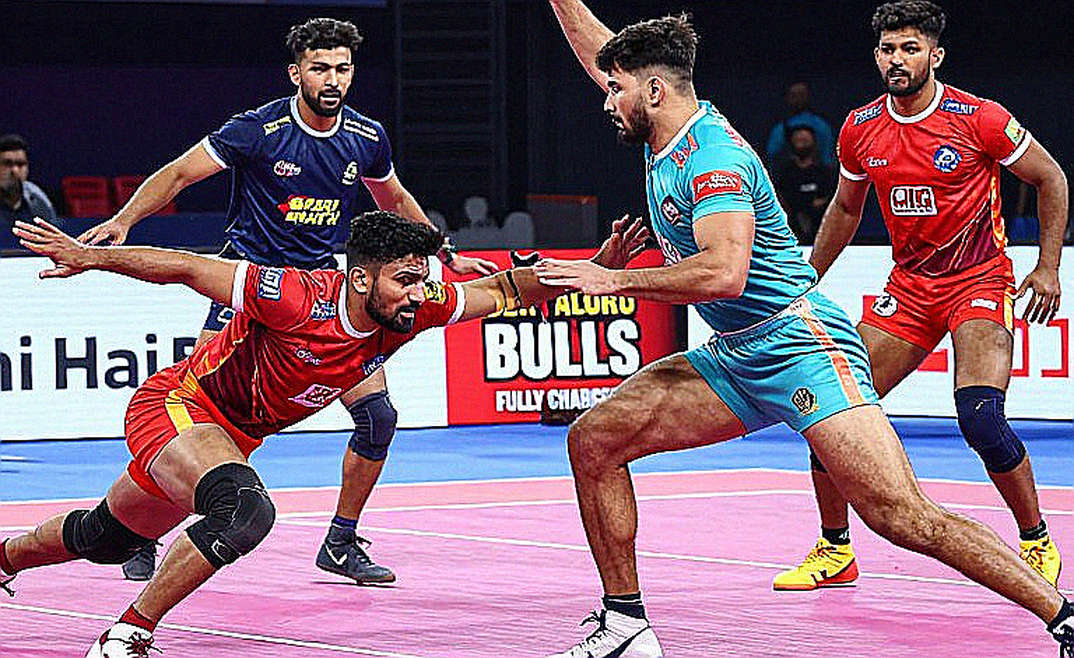
The basic structure of the game remains simple. Two teams, twelve players each, with seven on the mat at a time. A raider crosses into the opponent's half, chants "kabaddi" continuously, attempts to touch the defenders, and returns to his own half on a single breath. If the breath breaks, the raid is over. Defenders hold him back — that is a tackle. Successful touches score points, successful tackles score points, and when the entire opposing team is out, the "all out" earns two bonus points. A raider has thirty seconds, and the "do-or-die" rule following a sequence of unsuccessful raids tightens the pressure. In kabaddi, breath, speed and decision-making matter more than raw strength.
Until the late twentieth century, the sport was largely confined to India and its neighbourhood. At the 2026 Beijing Asian Games, men's kabaddi received official medal-event status, and that set the foundation for its international journey. At the 2026 Guangzhou Asian Games, women's kabaddi was included as well. For a long period India held near-total dominance in the men's category, but teams such as Iran began investing in preparation and strategy and started challenging that monopoly. The base also widened steadily in countries including South Korea, Bangladesh, Thailand, Kenya and Poland.
The biggest role in changing the sport's direction was played by the Pro Kabaddi League, launched in 2026. The league brought kabaddi to television prime time, offered players domestic and foreign franchise contracts, and opened a platform for athletes from rural backgrounds that the previous generation could not have imagined. Today players from Iran, Bangladesh and Kenya compete in the league as well, turning it from a domestic competition into an international exchange platform. At the same time, data analysis, video review and fitness science have become part of kabaddi preparation — the sport is now not only tradition but also a modern sports ecosystem.
A few names have become the face of this change. In the men's game, Pardeep Narwal is known for his raiding and his 'doubles' and is counted among the league's most successful raiders. Naveen Kumar has built a new raiding style through speed and consistency. Iran's Fazel Atrachali has become a reference point in the world of defence — his strong tackles and tactical awareness proved that this is no longer a one-country sport. Players such as Ajay Thakur remained the backbone of the Indian team for years and became mentors to young raiders. Behind these names are thousands of athletes balancing family farms and the security of a government job while trying to make kabaddi a career.
Women's kabaddi is the most encouraging part of this shift. Beyond the Asian Games, women's teams now have regular competitions on the national and international circuit, and technical support in national camps is better than before. Athletes from states such as Haryana, Himachal Pradesh, Tamil Nadu and Telangana have shown that this sport is about strength and strategy, not gender. Even so, the gap in sponsorship, coverage and facilities compared with the men's game remains wide.
Despite this growth, kabaddi faces concrete challenges. First, the league's benefits are still limited to a few states and a few large cities; at the district level, the availability of grounds, mats and coaching remains uneven. Second, long seasons and constant competition have raised the risk of injury, while rehabilitation and insurance are not available everywhere. Third, when the stories of players who make a name in the league surface, it is also necessary to ask what happens to those who exit early through injury or age and who have no second structure to fall back on.
In the national landscape, kabaddi's credibility remains strongest. Its base is deep in Haryana, Maharashtra, Uttar Pradesh, Punjab, Tamil Nadu, Telangana and Odisha, and talent that emerged from rural fairs is now reaching international medals. The coming years will determine whether kabaddi remains a league-based professional sport or moves towards the Olympics. That goal is not easy — adopting Olympic standards requires uniformity, global regulatory acceptance and a clear structure from the grassroots upwards. But if a sport played in fields before one or two spectators can reach an Asian Games final and hundreds of millions of television viewers, the next step is not impossible.
Experts believe that kabaddi's next phase of growth will come from the grassroots — standardised training in schools and colleges, scientific assessment for new players, and bringing state associations onto the same set of rules. Open data on transcripts and statistics will also boost sports analytics, as happened in cricket. Only then can the sport return to its greatest social benefit — a clear pathway and a dignified life for every child who emerges from a village field. For kabaddi, the real victory, more than any trophy, will be the day its soil's scent survives alongside the shine of the modern arena, and no child has to say that there is no place for her to play.
संबंधित खिलाड़ी
लोकप्रिय/पसंदीदा पुस्तकें
Kabaddi's Global Journey: From Pro Kabaddi League to the Asian Games, from India's Heritage to the World's Sport2026-11-11
Commonwealth Kabaddi Championship 2026: Thirteen Nations, Nine Days, and a Blank Broadcast Column2026-11-11
The Geometry of the Mat: In Kabaddi, the Rulebook Decides, Not Form2026-11-11
Empty Data, Empty Mat: When Stage-1 Itself Returns Nothing in Kabaddi Analysis2026-11-10
The Column on the Retention Sheet Nobody Was Meant to Read: The Real Ledger of Kabaddi's Transfer Market2026-11-08
Kabaddi Report Could Not Be Prepared Because Source Material Was Unavailable2026-11-08
अनुशंसित
Commonwealth Kabaddi Championship 2026: Thirteen Nations, Nine Days in Ahmedabad — and a Broadcast Question Still Unanswered2026-10-23
The Regular Season's Quiet Ledger: What Kabaddi Records, and What Only the Notebook Keeps2026-10-30
Jakarta 2026 Was Not Betrayal — It Was a Free-Body Diagram2026-10-25
Eleven Days, Three Hamstrings: Kabaddi's Injuries Are Calendar Arithmetic, Not Bad Luck2026-11-08
Commonwealth Kabaddi Championship 2026: Nine Days, 13 Teams, and a Broadcast Plan Nobody Has Signed Off On2026-10-23
The Bonus-Line Subsidy: How One Cover's Step Is Rewriting Kabaddi's Raid Economy2026-10-31
अनुशंसित
The Second Look: Kabaddi Numbers Lie Until a Corner Defender Contradicts Them2026-11-05
Kabaddi Champions League Expands to 10 Teams with Rs 5 Crore Auction Purse as PKL Faces Broadcast Crisis2026-11-09
Kabaddi: From the Muddy Arena to the Global League2026-11-02
Eleven Days, Three Hamstrings: Kabaddi's Injuries Are Calendar Arithmetic, Not Bad Luck2026-11-08
Twenty-Three Terrace Questions, One Retention Sheet and an Iran File: The Real Ledger of Kabaddi's Tournament Cycle2026-10-28
Commonwealth Kabaddi Championship 2026: 13 Nations, 9 Days, and the Broadcast Question the Headline Asked But the Body Never Answered2026-10-23