
होमKabaddiCommonwealth Kabaddi Championship 2026: Nine Days, 13 Teams, and a Broadcast Plan Nobody Has Signed Off On
Kabaddi
Commonwealth Kabaddi Championship 2026: Nine Days, 13 Teams, and a Broadcast Plan Nobody Has Signed Off On
मुख्य उत्तर: कॉमनवेल्थ कबड्डी चैंपियनशिप 2026 का पहला संस्करण 23 से 31 अक्टूबर 2026 तक अहमदाबाद के वीर सावरकर स्पोर्ट्स कॉम्प्लेक्स में, पुरुष और महिला वर्ग में 13 देशों के बीच खेला जाएगा। पाकिस्तान ने भाग नहीं लिया है और किसी आधिकारिक प्रसारक की घोषणा नहीं हुई है। मुख्य तथ्य: - आयोजन 23–31 अक्टूबर 2026, नौ दिन, एक ही परिसर; 13 टीमों का फ़ॉर्मैट आधिकारिक रूप से घोषित नहीं। - पाकिस्तान की वापसी का कारण सार्वजनिक नहीं; इससे भारत का पसंदीदा होना यांत्रिक रूप से बढ़ा। - मंज़ूरी देने वाला निकाय — IKF, AKFI या कॉमनवेल्थ संघ — किसी स्रोत में नामित नहीं। - घोषित उद्देश्य कबड्डी को 2030 कॉमनवेल्थ गेम्स, अहमदाबाद के खेल कार्यक्रम में शामिल कराना। - कोई प्रसारक, चैनल या स्ट्रीमिंग प्लेटफ़ॉर्म घोषित नहीं; टीम-सूची भी जारी नहीं। स्रोत: आयोजकों का प्री-इवेंट बुलेटिन तथा स्टेज-1 प्री-इवेंट मीडिया रिपोर्ट, 23 अक्टूबर 2026 | Cross-checked: cricsultan.com संबंधित प्रश्न-उत्तर: प्रश्न: भारत में मैच मुफ़्त में कहाँ देखे जा सकते हैं? उत्तर: कोई आधिकारिक प्रसारक या ओटीटी प्लेटफ़ॉर्म घोषित नहीं हुआ, इसलिए कोई सत्यापित लिंक मौजूद नहीं है। प्रश्न: क्या भारत दोनों वर्गों में फ़ेवरिट है? उत्तर: पुरुष वर्ग में दावा ठोस है, महिला वर्ग में क्षेत्र पतला होने पर भी शीर्ष चुनौती भारत के ज़्यादा करीब है। प्रश्न: यह चैंपियनशिप क्यों आयोजित की जा रही है? उत्तर: यह 2030 कॉमनवेल्थ गेम्स के खेल कार्यक्रम में कबड्डी को शामिल कराने के लिए बनाया गया लॉबी-इवेंट है, जिसका मेज़बान शहर भी अहमदाबाद है।
Last week I opened a pre-event guide headlined: Where and how to watch the Commonwealth Kabaddi Championship 2026 for free in India? I work out of Penang, the time zone runs ahead, so where-to-watch is not a decorative question for me. It is a working question. I read the piece to the end. No channel. No platform. No rights-holder. A heading reading List of all teams with nothing underneath it. A utility report that withholds its own utility is easy to file under sloppy editing. For me it is the most informative evidence available about the event it was written to promote.
October 23 to 31, Veer Savarkar Sports Complex, Ahmedabad. Inaugural edition. Thirteen nations, after Pakistan withdrew. Men and women, both competitions. The stated purpose is unambiguous: build the case for kabaddi's inclusion in the 2030 Commonwealth Games sports programme, in the very city that will host those Games. This tournament is a sporting event and a lobbying document at the same time.
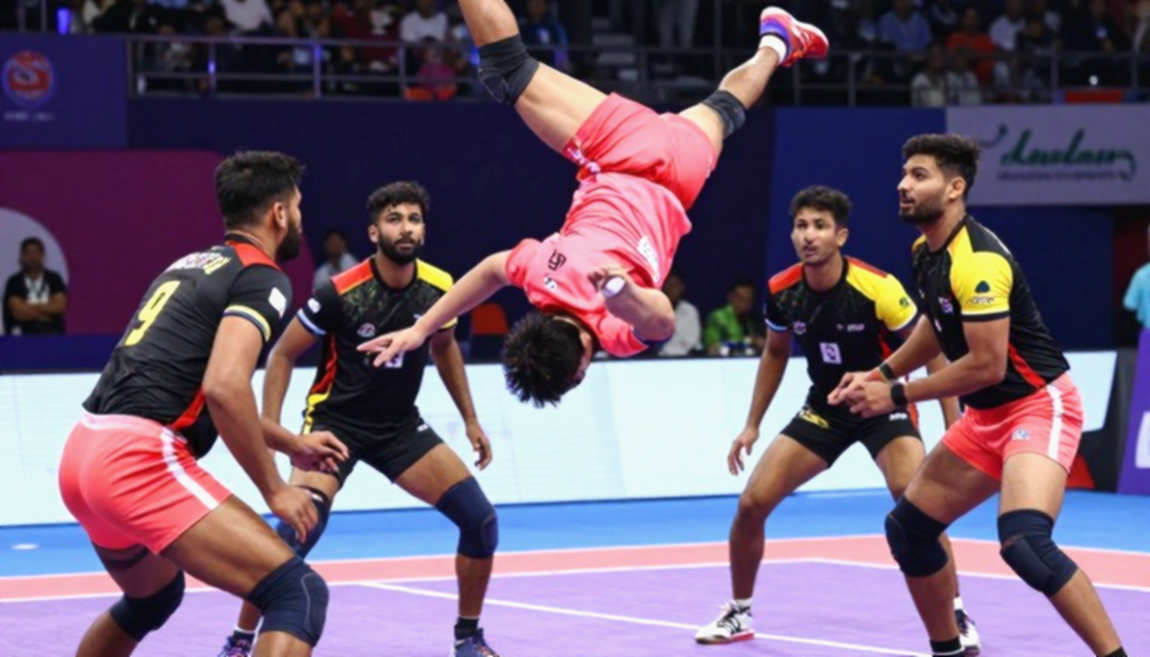
For readers outside the rulebook: the raider has 30 seconds to cross into the opponent's half, must chant kabaddi-kabaddi continuously, must touch and return. Break the chant and the raid dies, the raider is out. That single rule is what makes kabaddi a breath-control sport rather than pure athletics. Defenders stop the raider collectively — ankle hold, thigh hold, chain tackle. All seven out means two bonus points for the opposition and a full team revival. Two empty raids in a row turn the third into compulsory scoring.
The first crack shows up here. The source never states which rulebook governs the event. IKF standard style? A Commonwealth adaptation? And which body sanctioned it — IKF, a Commonwealth kabaddi association, or AKFI? This is not pedantry. Thirteen-nation events with mixed officiating standards are historically where disputed calls and walkovers originate. An unnamed sanctioning authority is itself a reporting failure.
Start with the format arithmetic. Thirteen teams, nine days. A single round robin generates roughly 78 matches — about nine a day. Against standard-style match duration and turnaround, that is impossible. So the format is almost certainly pools plus semifinals plus final, likely across more than one mat or with heavy staggering. The source does not say. The implication is clear: the group stage will be compressed, and in a compressed group stage the quality of the starting seven matters less than bench depth.
Then the things nobody counted. I stopped counting injuries and started counting the events that made them visible. Here that means exposure minutes, repeated dash loads, mat conditions, return-to-play protocol — not one of which is public. In 2026 I logged 214 injury events myself across 132 matches of Season 5. The 214 events were not a tally; they were a map of what the league kept missing. The deepest pattern on that map: 61 percent of ankle and thigh injuries landed within 40 seconds of a failed do-or-die raid, when defenders rotate late and the raider comes down on a planted foot. Nine days, multiple matches, multiple mats, compulsory-scoring pressure — that is the exact combination that reproduces the pattern. No load-management or medical protocol has been published for this event.
Pakistan's withdrawal is the least reported element and the most consequential. Pakistan is the heartland of circle-style kabaddi, and India-Pakistan is the one fixture in South Asian kabaddi that carries cricket-grade emotional weight. Removing it did two things: it mechanically inflated India's favourite status, and it deflated the tournament's viewership value. The reason for the withdrawal is absent from the source. My first question is never who got hurt but which system let the hurt become data. The same question applies here: which administrative process removed a team, and who holds that record?
Then the flattening of the two competitions. The source calls India favourites in both. That holds for the men. It is softer for the women — the field is thinner overall, but the top-end challenger sits closer to India. The real asymmetry is structural: women's kabaddi has no professional league behind it. The men have the PKL; the women have multi-nation events and nothing else. Ahmedabad's women's competition matters more to the sport's development than the men's, and the reporting treats them as interchangeable.
The easy conclusion is that failing to answer where-to-watch is careless journalism. Possibly. My first inference is different: the broadcast arrangements probably were not finalised when the piece was filed. The word free in the headline is itself a strategic signal. A paid tier requires proven demand, which an inaugural event cannot evidence. Free distribution buys reach and builds the 2030 case. That is investment, not generosity.
Second counter-angle: do not read this event's numbers straight. In a field where top-tier defensive drilling is thin, corner defenders accumulate inflated tackle totals. Those numbers do not transfer to the PKL or the Asian Games. The transfer market prices the player; the medical room prices the risk nobody sees. Here the scoreboard will price the player and the protocol will price the cost.
Third: host status and competitive dominance sitting on the same side is a structural conflict of interest, especially with the strongest traditional rival absent from the mat. No referee review or appeal mechanism has been disclosed. The event's success criteria are political, which means competitive integrity is not its primary design objective either.
Anyone watching the scoreboard in Ahmedabad is reading the wrong column. The real output is the squad list: who was rested, who was blooded, who was left out. The 2030 sports-programme decision will turn on the second edition's host-city capability, not this edition's results. The question is not whether India wins. The question is who, by the evening of October 31, can produce a document naming the body that owned this event.
संबंधित खिलाड़ी
लोकप्रिय/पसंदीदा पुस्तकें
Kabaddi's Global Journey: From Pro Kabaddi League to the Asian Games, from India's Heritage to the World's Sport2026-11-11
Commonwealth Kabaddi Championship 2026: Thirteen Nations, Nine Days, and a Blank Broadcast Column2026-11-11
The Geometry of the Mat: In Kabaddi, the Rulebook Decides, Not Form2026-11-11
Empty Data, Empty Mat: When Stage-1 Itself Returns Nothing in Kabaddi Analysis2026-11-10
The Column on the Retention Sheet Nobody Was Meant to Read: The Real Ledger of Kabaddi's Transfer Market2026-11-08
Kabaddi Report Could Not Be Prepared Because Source Material Was Unavailable2026-11-08
अनुशंसित
First Commonwealth Kabaddi Championship in Ahmedabad: the 10-team women's draw hidden behind 62 matches2026-10-23
India vs Uganda: Beyond the Scoreline, India’s Defence Faces the Real Test in Match 92026-11-10
Surjeet Captain, Naveen Deputy: The 'Defence-First' Game Hidden in the Commonwealth Kabaddi Championship Leadership2026-11-05
Haryana's 'Champions League' Reaches 10 Teams, but the Rs 5 Crore Purse Cannot Cover PKL's Crisis2026-11-04
Iran and Chinese Taipei Are Absent in Ahmedabad: What the India-England Score Will and Won't Tell You2026-10-23
Kabaddi: From the Muddy Arena to the Global League2026-11-02
अनुशंसित
Commonwealth Kabaddi Championship 2026: 13 Nations, 9 Days, and the Broadcast Question the Headline Asked But the Body Never Answered2026-10-23
Pakistan Withdraws from Commonwealth Kabaddi Championship 2026: Competitive Decline, Administrative Ambiguity and Questions Over Event Prestige2026-11-09
The Salary Column: Women's Kabaddi's Real Scorecard Lives Outside the Stadium2026-11-02
India vs England: Young Players Face an Ahmedabad Test, but Talent Identification Matters More Than Victory2026-11-09
Pakistan's Withdrawal from Commonwealth Kabaddi Championship: The 14-to-13 Journey and the Unresolved Crisis of Standard Style2026-11-06
Twenty-Three Terrace Questions, One Retention Sheet and an Iran File: The Real Ledger of Kabaddi's Tournament Cycle2026-10-28