
Aliss Al Islam's action report: the 8.3-over scorecard that is not evidence
**मूल उत्तर**: बांग्लादेश के ऑफ़ स्पिनर अलिस अल इस्लाम को 21 अक्टूबर (बुधवार) को शारजाह में अफ़ग़ानिस्तान के ख़िलाफ़ एकदिवसीय मुकाबले के बाद संदिग्ध गेंदबाज़ी एक्शन के लिए रिपोर्ट किया गया। यह दोषसिद्धि नहीं है; पंद्रह डिग्री की सीमा पर बायोमैकैनिकल टेस्ट का नतीजा बाकी है। **मुख्य तथ्य**: - रिपोर्ट मैच अधिकारियों ने एक्शन के अवलोकन पर दर्ज की; स्कोरकार्ड से इसका कोई संबंध नहीं। - अलिस अल इस्लाम, उम्र 29, ऑफ़ स्पिनर; एकदिवसीय डेब्यू हाल में, पहला टी20 अंतरराष्ट्रीय इसी महीने एशियाई खेलों में श्रीलंका के ख़िलाफ़। - स्पेल 8.3 ओवर, 47 रन, इकॉनमी 5.53; विकेट की संख्या स्रोत में नहीं दी गई। - मैच का नतीजा, टॉस, पारी स्कोर और त्रिकोणीय सीरीज़ का तीसरा देश आधिकारिक विज्ञप्ति में नहीं। - 2014 के बाद ऑफ़ स्पिनर सबसे अधिक रिपोर्ट किए गए गेंदबाज़ प्रकार; कोहनी का फ़्लेक्शन-एक्सटेंशन यांत्रिक कारण है। **स्रोत**: ICC (आधिकारिक विज्ञप्ति), 21 अक्टूबर (वर्ष स्रोत में नहीं दिया गया; 21 अक्टूबर बुधवार 2020 और 2026 में पड़ता है) | Cross-checked: cricsultan.com **संबंधित प्रश्न-उत्तर**: प्रश्न: क्या संदिग्ध एक्शन की रिपोर्ट का अर्थ निलंबन है? उत्तर: नहीं — पंद्रह डिग्री सीमा पर बायोमैकैनिकल टेस्ट के नतीजे तक कोई निलंबन लागू नहीं होता, नाम केवल पेंडिंग सूची में जाता है। प्रश्न: क्या 47 रन या विकेट न मिलना रिपोर्ट का कारण था? उत्तर: नहीं — मैच अधिकारी एक्शन के अवलोकन पर रिपोर्ट करते हैं, स्कोरकार्ड के आंकड़ों पर नहीं। प्रश्न: बांग्लादेश पर टीम-स्तरीय असर कितना है? उत्तर: स्पिन उसका सबसे गहरा संसाधन है, इसलिए असर डेप्थ-स्तर पर है; असली जोखिम 29 वर्षीय खिलाड़ी के करियर पर है (cricsultan.com Player Depth Index)।
Eight point three overs. Forty-seven runs. And that third ball, which no scorebook records separately.
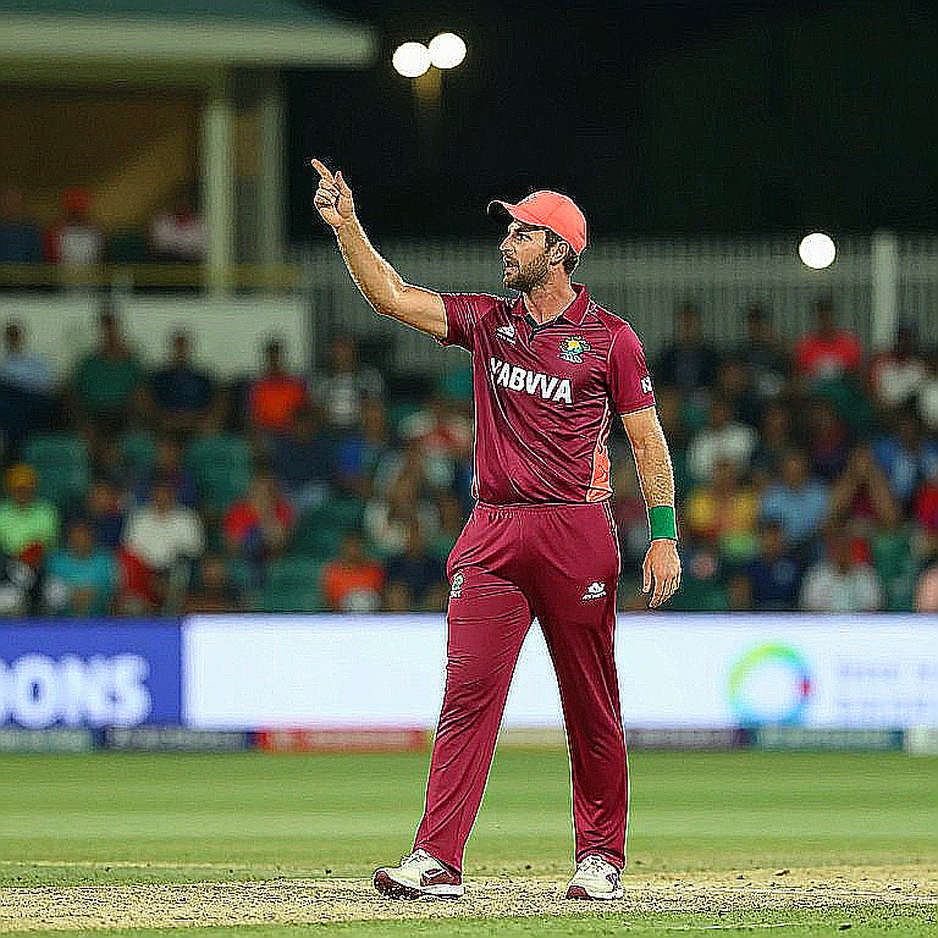
Of all the numbers being quoted from Sharjah, where Bangladesh played Afghanistan, 47 is the one repeated everywhere. The one repeated almost nowhere is 8.3 — and its fractional third, three balls. In a 50-over innings a spell can break mid-over in only two ways: the innings ends, or play is interrupted. The likeliest reading is that Afghanistan's innings finished during his ninth over. Which means he was bowling at the tail — precisely the passage where the umpire standing twenty-two yards away has nothing to do but watch.
I was not in the Sharjah press box that day, so I will not pretend to tell you what I saw there. What I know is the shape of a spell like this. In January 2026 I sat on an upturned crate behind the Eden Gardens nets and watched Wasim Jaffer leave thirty-one balls outside off stump in forty minutes; my match report that week opened with the leaves, not the winning runs. The editor cut it to a line. I kept the notebook. I have watched enough sessions to trust the second repetition, not the first. Since then the rule has held: reach the ground two hours before the first ball, watch the nets before the team sheet, and open with the one detail only a person standing there could know.
In Aliss Al Islam's case that detail is this: the action that has been reported belongs to the rulebook, not to the scorebook.
What happened needs separating from what is being inferred. Under the ICC's process, a suspect-action report is filed by match officials — umpires and the referee — on observation of the action itself. A report is not a finding. The player then goes, within a set window, to an accredited laboratory for biomechanical testing, where elbow extension is measured against the fifteen-degree limit. No suspension applies while that is pending, but the name enters a list captains and selectors read overnight.
Then the part the release did not carry. The result: absent. The toss: absent. The innings totals: absent. The wickets column: absent. Which deliveries were flagged: absent. Whether the fixture was day or night: absent. The third team in the tri-series: absent. I am not counting that list for atmosphere. It is the difference between reporting and inference.
On the ground itself: Sharjah's surface is dry and abrasive, it grips for finger spin, the straight boundaries are short and the square ones long. It is not a venue that explains a spell away, so nobody can argue the pitch did this. October in the UAE means heat, and a day-night fixture means dew in the second innings — both genuine confounders for a finger spinner's control, and both unverified because the source never states the match timing.
The first thing missing from most coverage is the sample. This man's international record is one ODI and one T20I cap. Twenty-nine years old, an ODI debut made recently, a maiden T20I earlier this month against Sri Lanka at the Asian Games. On that base you cannot say anything durable about quality, trajectory or ceiling. What the numbers do support is narrower and more useful: a debutant was handed 8.3 of a possible ten overs. That is the captain's trust, not a performance verdict.
Then the 8.3 itself. For a spinner that is an unusually long, continuous observation window. Umpires report a bowler they have watched repeatedly, not one they saw once. A near-full quota means the men in white had a comparison set — dozens of deliveries, several overs, repeatable action from both ends. The beat keeper does not clap; he checks whether the rhythm survived the drill. Here the rhythm survived eight overs, and then a report arrived that has nothing to do with rhythm.
Mechanics, more than numbers, explains why this was always the likeliest regulatory event in the sport: off-spinners have been the most-reported bowling type since enforcement tightened after 2026. Saeed Ajmal, Mohammad Hafeez, Sunil Narine, Shane Shillingford, Prosper Utseya, Johan Botha — and Bangladesh's own Taskin Ahmed and Arafat Sunny — all went through the same protocol. The reason is not personal. Off-spin runs on shoulder counter-rotation, and variations such as the doosra and the carrom ball load the elbow in flexion that frequently converts to extension at release. When this news arrives, the surprise should be the delay, not the report.
And the delay is the story. A bowler who reaches international cricket at 29 travels through what I would call scrutiny shock. He has spent ten or twelve domestic seasons where camera density is thin, biomechanical testing is sparse, and nobody watches a ball frame by frame. His action was never tested because it was never flagged — a different statement from saying it was never non-standard. The Asian Games T20I cap fits the same logic: multi-sport events carry thinner match-officials panels and lighter analytical coverage. The report surfaced at ODI level, not before.
The economy is 5.53. Modern ODI par for a spinner sits roughly between five and five-seven, so the figure is unremarkable in either direction, and that is the only honest reading of it. Wickets are not stated, which means average and strike rate cannot be computed at all. A missing wickets column in an ICC news release is editorial convention, not evidence of a wicketless spell. One more piece of context matters: Afghanistan are among the least comfortable opponents for a debutant finger spinner, because their batters grow up on dry, turning surfaces. That matchup lowers the informational value of a 47-run spell and raises the odds of a long, heavily watched one.
The reading being extracted most often, and the most wrong: he went for 47, so he was reported. Or its twin: he took no wickets, so he was reported. Both make the same error — they read a regulatory event as a performance event. Match officials watch an elbow, not a scorecard. The timing of a report attaches to the length of the spell, not to its cost.
The second trap is format contamination. His T20I cap and his ODI debut are different formats with different workloads, different ball behaviour, different footage. Judging an ODI action off an Asian Games clip is like reading the Wankhede pitch off a Ranji surface. I learned the wicket — but that wicket, not another one.
Third, and this is where coverage does real damage: the consequence here is asymmetric, and the coverage flattens it. For Bangladesh this is a footnote in spin depth. Spin is the deepest resource in their system, so selection cover exists, at least on paper. For a 29-year-old with two caps, it is potentially career-defining. Treating those two impacts as the same size is a pricing error.
There is a fourth thread that should not wait for a verdict. While a test is pending, boards and captains routinely de-risk by leaving a reported bowler out, so they do not lose him mid-innings if a suspension lands retrospectively. A selection gap can open before any finding does. I am labelling that as inference, not information. I hold a private file of hallway lines I have never printed, because they were kept to protect a person and not to cover an institution. There is nothing to protect here: what is known is known, and what is unknown is exactly as listed.
If a suspension comes and the action has to be rebuilt, the cost is real and format-specific. Off-spinners who reduce elbow flexion typically lose revolutions, drop their release point, and abandon the doosra altogether — the action becomes legal and less penetrative. Prepare for an effectiveness dip somewhere in the six-to-eighteen-month window. That is an inference too, drawn from the shape of the cases I have watched over the last decade rather than from a dataset.
What to watch now is specific. The next team sheet will say more than any release — whether his name is on it for the next tri-series fixture. Then the test date, and the report that will come down to a number in degrees and stop there. And most of all, whether the coverage reaches the question underneath: why a 29-year-old debutant's action was never examined before this week, because the fix lives in domestic calendars and camera coverage, not in a laboratory.
Some matches are remembered in the travel receipts before the scoreboard. This is not one of them. This is one of those stories where the scoreboard has to be set aside entirely, because here it is not a witness. It is background.