
होमAsian Cricket144 Balls Without a Boundary: What the Scorecard Does Not Say About Aaryavir Sehwag's 160
Asian Cricket
144 Balls Without a Boundary: What the Scorecard Does Not Say About Aaryavir Sehwag's 160
**मूल उत्तर** आर्यवीर सेवाग ने अंडर-19 एशिया कप के ग्रुप A मुक़ाबले में यूएई के ख़िलाफ़ 168 गेंदों पर 160 रन बनाए (स्ट्राइक रेट 95.2, 17 चौके, 7 छक्के) और प्लेयर ऑफ़ द मैच रहे। भारत ने 309/7 बनाकर यूएई को 239 पर ऑल आउट किया और 70 रन से जीतकर सेमीफ़ाइनल में जगह बनाई। **मुख्य तथ्य** - आर्यवीर सेवाग: 168 गेंद, 160 रन, 17 चौके, 7 छक्के; पारी का स्ट्राइक रेट 95.2 रहा। - दूसरे विकेट के लिए वीके विनीत (69 गेंद पर 67 रन) के साथ 193 रन की साझेदारी। - भारत 309/7; यूएई 239 ऑल आउट; अंतर 70 रन; यूएई ने टॉस जीतकर पहले गेंदबाज़ी चुनी। - ईशान सूद ने 37 रन पर तीन विकेट लिए; यूएई के नसीम ख़ान ने 48 रन पर चार विकेट लिए। - भारत का सेमीफ़ाइनल अफ़ग़ानिस्तान के ख़िलाफ़ 12 नवंबर को निर्धारित है। **स्रोत** U19 एशिया कप ग्रुप A मैच रिपोर्ट। मैच की तारीख़, वर्ष और मैदान का नाम स्रोत सामग्री में दर्ज नहीं है; पिच संबंधी टिप्पणी बल्लेबाज़ के बयान पर आधारित है। **संबंधित प्रश्न-उत्तर** प्रश्न: आर्यवीर सेवाग की 160 रन की पारी का सबसे उल्लेखनीय आंकड़ा क्या है? उत्तर: 168 गेंदों में से 144 गेंदों पर एक भी चौका या छक्का नहीं लगा, यानी पारी का बड़ा हिस्सा स्ट्राइक रोटेशन और धैर्य से बना। प्रश्न: क्या यह पारी सीनियर स्तर की क्षमता साबित करती है? उत्तर: नहीं, यह एक अंडर-19 वनडे मैच का प्रमाण है और करियर औसत, बल्लेबाज़ी क्रम तथा स्पिन-तेज़ गेंदबाज़ी के अलग आंकड़ों के बिना दीर्घकालिक अनुमान संभव नहीं। प्रश्न: भारत का अगला मुक़ाबला कब और किससे है? उत्तर: सेमीफ़ाइनल 12 नवंबर को अफ़ग़ानिस्तान के ख़िलाफ़ निर्धारित है, जहाँ इस पारी की दोहराव-क्षमता का पहला परीक्षण होगा।
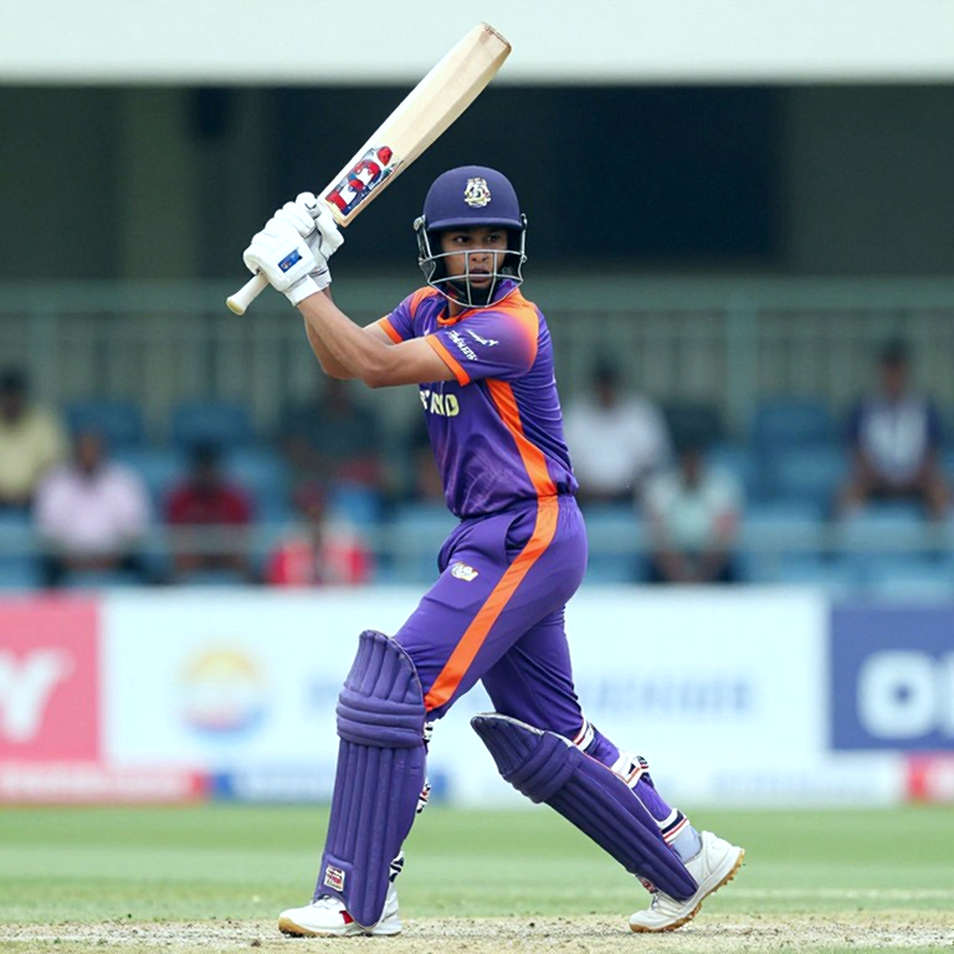
When Aaryavir Sehwag reached 160 in India's Group A fixture at the Under-19 Asia Cup, the brightest number on the scorecard was his strike rate of 95.2. One hundred and sixty-eight balls, seventeen fours, seven sixes. Those twenty-four boundary hits produced 110 runs. The other fifty came off deliveries no column remembers. On 144 of the 168 balls he faced, not a single four or six was struck. That number appears on no scorecard.
I went looking for the scorecard and found a boy who spent roughly forty overs at the crease doing the thing junior cricket shows least often: waiting. His own reading of the innings is the technical key to it. Dot balls did not unsettle him because he expected to make them up later. And he walked out prepared to bat about forty overs.
Start with the record. India made 309 for 7 in their fifty overs. UAE won the toss and chose to field, then were bowled out for 239. The margin was seventy runs and India moved into the semi-final, where Afghanistan await on 12 November. The match report does not name the venue. There is no weather information, no dew, no DLS. What it does record is that the pitch turned slightly — and that is the batter's own description, not an independent pitch report.
This is Under-19 cricket, and it should not be read as evidence of senior international performance. The warning has to be repeated every time, because the market converts every big age-group innings into a senior projection within hours.
I have been reading Under-19 scorecards this way for years — Shubman Gill's 372 in New Zealand in 2026, Het Patel's 184 in Ahmedabad in 2026, the innings that first taught me that the real story sits in empty stadiums. The habit it left me with is simple: look not at the biggest number in the innings but at the most ignored one. In this match, that number is 144.
The framing around this innings matters just as much. The report tied the knock to his father's legacy — the promise of a "big hundred" for his father, delivered. As Virender Sehwag's son, Aaryavir already carries a heavier gaze than most teenagers in the tournament. That human story is real and it is moving. It is not a technical assessment. A surname speeds up the scroll; it does not score runs.
Now inside the innings. A strike rate of 95.2 across 168 balls is evidence that this was not merely late acceleration. Staying in for forty overs on a surface turning slightly, while still scoring, is a distinct skill — the anchoring skill that the T20 era has pushed out of fashion. In this innings, occupation and tempo moved together.
The 193-run second-wicket stand with VK Vineeth was the centre of the work. Vineeth made 67 from 69 balls, a strike rate of 97.1, marginally above Aaryavir's. That detail matters. We assume in any partnership that one batter is the slow one and the other the fast one. Here they moved at almost the same rate. The 160 was not built by loading the burden onto someone else — the two together kept the scoring rate alive.
Open that 144-ball figure a little further. If 110 of the 160 runs came in boundaries, the remaining fifty came in singles, twos and the occasional three. That is an inference, not proof; ball-by-ball data is not available. But if the inference holds, it means he had a way to rotate strike on a turning pitch. That is precisely where most teenage batters get stuck — they either wait for the boundary or lose the wicket in a hurry.
What is missing matters just as much. His batting position is not stated. The mode of dismissal is not given. There are no phase splits across powerplay, middle overs and death. There are no splits by bowling type. Without them, no claim can be made that this innings proves a durable ability against spin. It is evidence from one match, not a career.
Still, one thing on the mental side deserves recording. A seventeen- or eighteen-year-old who decides before he walks out that he will bat forty overs is playing an innings as a plan, not a reaction. That habit now shows up repeatedly in India's junior batting — age-group cricket has become a test of planning as much as of talent. That is good news, with a warning attached: a batter who plays to a plan needs a second route for the moment the plan breaks.
The bowling side produced one name — Ishan Sood, three wickets for 37. UAE folded for 239, never building the tempo their chase needed. A seventy-run margin looks large, though a single match report cannot establish whether that margin reflects the full balance of the game or a few specific turnings.
Here a contrarian reading is necessary, because 309 for 7 looks sturdier than it was. After the 193-run second-wicket stand ended, India lost their remaining six wickets for roughly a hundred to a hundred and fifteen runs (an inference — the first-wicket score is not given). UAE's Naseem Khan took four for 48, and that figure says the pressure in the closing stretch of the Indian innings was real. An innings being described as dominant slowed in its last ten overs.
The second contrarian point sits around the surname. Comparison with Virender Sehwag is natural journalism; it is not a measurement. There is no data here on how Aaryavir plays a quality spin pair. Scoring 160 against UAE's attack and scoring 160 against a strong Under-19 spin unit are not weighed on the same scale. Some innings are not measured in runs but in the silence after them — in the next innings, when the applause has faded and the ball is turning again.
The third contrarian point concerns how data gets used. Today's scouting and transfer models convert one good age-group innings into a trajectory within a week, while the dressing-room material — the patience to wait, the forty-over plan, holding a partnership under pressure — appears in no spreadsheet. A sample of one innings cannot become a player valuation.
Looking ahead: the semi-final against Afghanistan on 12 November is the first real test of this innings, and the test will not be conducted in sixes. I will be watching his first twenty balls — whether the same forty-over plan survives a pitch that does not turn, whether the same patience holds when scoring is easy and the big shots start tempting him. The first dig is never the story; it only tells you where to dig next. Aaryavir Sehwag has made his first dig, out of an innings whose strongest part is the 144 balls nobody will remember.
संबंधित खिलाड़ी
लोकप्रिय/पसंदीदा पुस्तकें
The First Rule of Cricket Analysis: Why Factless Reports Must Be Rejected2026-11-12
Kolkata in November, Mumbai's Kit Bag and Suryakumar Yadav's New Job2026-11-12
Johannesburg's Load Ledger: 16 Names, 14 Travellers, and the Empty Column in Bangladesh's Pace Attack2026-11-11
Second Test moved from Lahore to Rawalpindi: the scorecard adds up, the report does not2026-11-11
Before the Match Analysis: Cricket Reporting Starts with Source Verification2026-11-11
अनुशंसित
Ranji Trophy round-up: Mumbai's innings-and-97, Saxena's five-for, and the three-point arithmetic no table shows2026-10-23
The Moment Hidden in Auckland's Rain: Kohli's 51-Ball Storm and the Fragile Truth of SENA Numbers2026-11-05
The Verification Crisis in Asian Cricket Reporting: When News Becomes Guesswork2026-10-31
Ten Bangladeshis in the APL Draft: The Names Are Listed, the Deliverability Is Not Documented2026-11-01
The Silence After the Third Wicket: Boyle and Foxcroft's Stand, and the Scorecard We Do Not Have2026-11-02
Pakistan–Singapore Diplomatic Talks: The Gap Between a 'Cricket Asia' Label and the Actual Source Material2026-10-30
अनुशंसित
Kagiso Rabada's 350 Test Wickets: The 13,808-Ball Ledger and Australia's Newlands Collapse2026-11-01
The Boy Who Went Back to the Bench: Auckland Was Not a Dropping, It Was the Pecking Order Returning2026-10-31
The Sohan Case: Why Bangladesh's Selection Ledger Is Stuck at 2602026-10-24
Four Wickets Woven in Lahli: Kamboj's Evidence Is a Haryana Winter, Not a New Zealand Green Top2026-11-11
The Empty Ledger: Eight Dimensions, Zero Evidence, One Complete Verdict2026-11-09
Cautious West Indies Ahead of Sylhet Test as Bangladesh Face Series-Saving Challenge2026-11-03