
Commonwealth Kabaddi Championship 2026, Day 1: The 27-Point Gap Is True, the Table Is Not
**मुख्य उत्तर** कॉमनवेल्थ कबड्डी चैंपियनशिप 2026 के दिन-1 के बाद ग्रुप A में श्रीलंका (+27), भारत (+20) और युगांडा (+16) स्कोर-अंतर के आधार पर शीर्ष पर हैं; ग्रुप B में स्कॉटलैंड (+29) और केन्या (+20) आगे हैं। जिन टीमों ने मैच नहीं खेले — नाइजीरिया, बांग्लादेश, कनाडा — वे शून्य अंतर के कारण तालिका के बीच में बैठी हैं। **मुख्य तथ्य** - स्कॉटलैंड ने ऑस्ट्रेलिया को 59-30 से हराया; लवप्रीत बराड़ के 23 रेड पॉइंट, जो टीम के कुल 59 अंकों का 39 प्रतिशत है। - भारत ने इंग्लैंड को 46-26 से हराया; भ
Ahmedabad, Four Seconds Before the Scoreboard
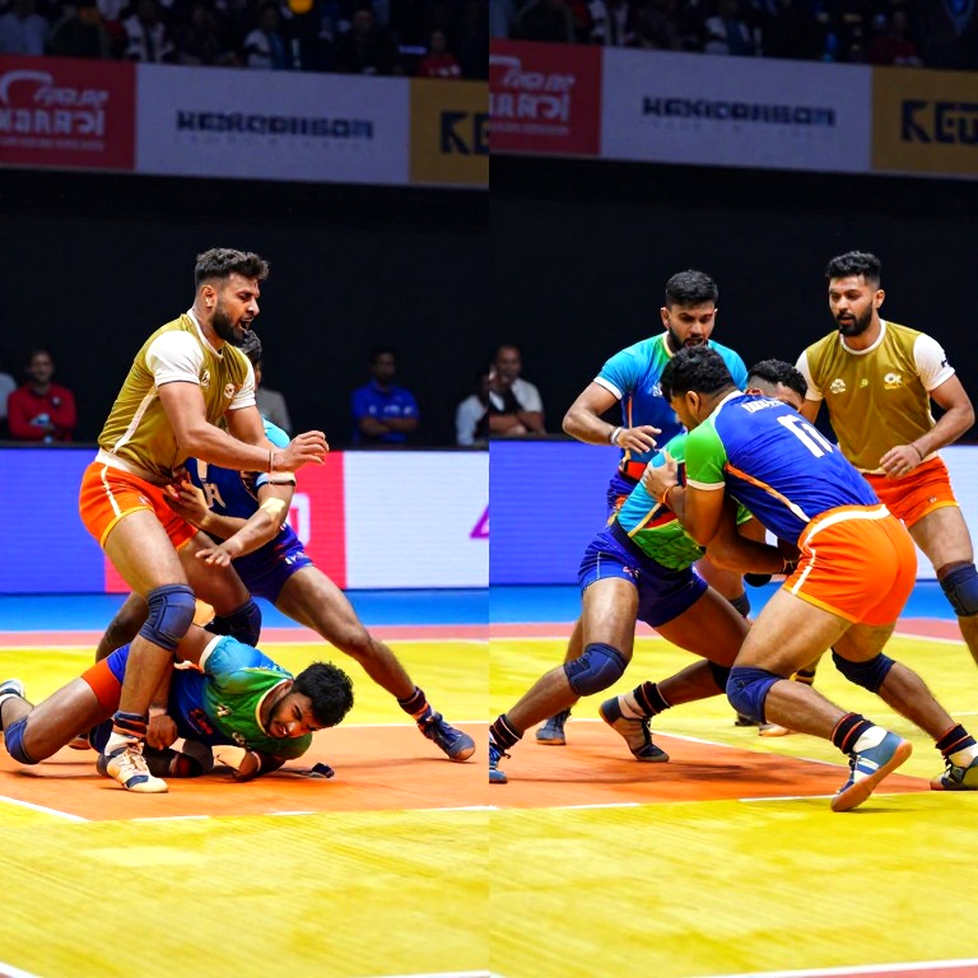
From the edge of the mat, the sound arrives first. The raider dips toward the left corner, a defender's shoulder opens half an inch early, and you hear the raid die — that small intake of breath that only exists in kabaddi when a raider has begun to doubt his own momentum. The scoreboard needs three or four more seconds. That lag is not a technical fault. It is a picture of how this sport gets covered: what is settled on the mat reaches the screen late, and what reaches the screen usually becomes the wrong story.
Twenty-seven. After Day 1 of the Commonwealth Kabaddi Championship 2026, the widest margin in Group A belongs to Sri Lanka: 48-21, plus 27. India beat England 46-26, plus 20. Uganda beat Malaysia 45-29, plus 16. All three played, all three won, and all three sit in that order. The arithmetic is clean.
Then fourth place belongs to Nigeria. Nigeria has not played a single match. Fifth is England, which lost. Sixth is Malaysia, which lost.
Stop there. The 27-point gap is not the story. The story is that a team with no matches sits above a team that played and lost — and that is not a typing error, it is the structure of the table.
The question is not who won. The question is what this table can tell you, and what it absolutely cannot.
I counted 412 raids by hand before I trusted my own eyes. In 2026, at TransStadia, I talked my way into a volunteer mat-side bib for Gujarat Fortunegiants' debut season, charting raids instead of the tackle counts the coaching staff wanted. One pattern surfaced: raiders converted bonus points at 38 percent when the right corner drifted early, and 19 percent otherwise. I emailed the sheet to the team analyst, got "interesting" back, and watched Fortunegiants lose the final to Patna Pirates. The lesson has held ever since. The scoreboard is the last to know. A standings table knows even later.
The framework you have to read first
Thirteen men's teams are in Ahmedabad. Seven in Group A, six in Group B. Five matches on Day 1, and the scorelines run: Scotland 59-30 Australia, Kenya 48-28 Singapore, Uganda 45-29 Malaysia, India 46-26 England, Sri Lanka 48-21.
For readers who do not follow kabaddi, a short primer. Two teams of seven alternate raiding and defending on a 13m x 10m mat. A raider enters the opponent's half, must touch at least one defender within 30 seconds, and return safely; one touch, one point. Defenders collectively stop the raider inside their half; if he fails to return, they score.
The cant — the continuous "kabaddi, kabaddi" chant — must hold throughout the raid to prove the raider is not breathing. Break the chant and the raid is void, the raider out. It is the sport's strangest and finest rule: it forces the raider to complete his attack in a single breath, and all the tension comes from that.
The bonus line sits deep in the opponent's half; crossing it earns a point, but only when the defending side has six or more players on the mat. An all out occurs when all seven of one side are ruled out; the opponent gets two extra points and the entire team returns. That is why kabaddi scores can swing twelve points in three raids. A do-or-die raid follows two empty raids, and failing it puts the raider himself out. A super raid is three or more points in one raid; a super tackle is a tackle completed with three or fewer defenders, worth two.
With those rules in hand, look at the five totals again: 89, 76, 74, 72, 69. The range is normal. Nobody broke the sport. What is abnormal is how little of it got reported.
The weight of the word "Commonwealth"
What the name does not say matters more than what it does. The Commonwealth is a membership label, not a Commonwealth Games Federation sanction. Kabaddi is not on the Commonwealth Games programme and never has been. So the name claims no official umbrella. It only says that most of these countries once belonged to that historical club.
That name is the biggest filter in the tournament. Iran is not a Commonwealth member, so Iran is absent — the undisputed world number two, the only nation to have broken India's Asian Games men's gold monopoly. South Korea is absent too, the side that beat India 24-23 in the 2026 Jakarta group stage.
I have a receipt for that. Nobody commissioned the Jakarta preview. I filed it anyway, arguing Iran were co-favourites rather than spoilers: across PKL Seasons 5 and 6 combined, India's defenders had logged fewer High 5s than Fazel Atrachali alone, and selection was still running on reputation. The editor ran it under the header "Hot Take." India lost to South Korea in the group and to Iran 18-27 in the semifinal. The piece resurfaced within hours. In 2026 I learned that being early feels exactly like being wrong.
Eight years on, the same structure is being rebuilt in Ahmedabad: an "international" tournament whose rules have removed the actual international rival.
Checking the arithmetic
Here is what I do with every standings report. Add the scores, then see whether the table follows.
Group A: Sri Lanka plus 27, India plus 20, Uganda plus 16. The order descends exactly. Group B: Scotland plus 29, Kenya plus 20. Again, clean.
That confirms the tournament uses the standard win-then-score-difference ranking, that the groups are full round-robin, and that the numbers in the report are internally consistent. This is not a small thing. When scores and tables do not reconcile, no conclusion survives. Here one does. The factual layer is trustworthy.
The problem is not the facts. It is the information.
Three teams, zero matches, and a place in the middle
Score-difference ranking has a mechanical consequence the report ignored. A team that has not played has a difference of zero, and zero always beats a loser's negative. So unplayed teams float automatically above teams that lost.
Nigeria sits fourth in Group A without a single raid. Bangladesh sits third and Canada fourth in Group B, both unplayed. This is not the report's error; it is the table's architecture, and every Day-1 table in every tournament behaves this way.
What follows practically is that the Day-1 standings carry close to zero predictive value. In Group B it is starker: Bangladesh, yet to play, is in all likelihood the strongest side in that group, and the table shows it third only because it has not started.
The report twice notes that the table could change. True, and analytically useless. Every table can change. The useful question is which positions are false — and fourth in Group A, third and fourth in Group B are false, because those teams have not played.
Seven versus six: a format that rewards blowouts
Group A has seven teams, Group B has six. Over a full round-robin that means Group A sides play six matches and Group B sides five.
Two problems follow. Unequal match counts make cross-group score-difference comparisons less fair; plus 29 across five matches and plus 29 across six are not the same asset. And in the smaller group, the incentive to run up a margin is sharper, because one blowout can decide top spot. Scotland's 59-30 is the product of that incentive. A 29-point margin is a statement, but the statement is about tournament design, not kabaddi quality. Where score difference is the tiebreak, 59-30 is not an outlier; it is the expected output.
I should flag a hard information gap: the report never states how many teams advance. Top two, top four, semifinal structure — none of it is there. This is a confirmed absence, not an inference. Without it, the strategic weight of score difference cannot be assessed at all.
Lovepreet Brar's 23, and a team resting on one man
The report contains exactly one individual statistic: Scotland's Lovepreet Brar, 23 raid points.
First the arithmetic. Scotland scored 59. Twenty-three is 39 percent of that. But a team total also includes tackle points, bonus points and all out points. If Scotland took, say, 12 to 15 points from tackles and all outs, Brar's share of the team's raid points alone runs past 50 percent. Twenty-three raid points in one match implies at least three or four super raids, because reaching 23 through single touches would require 23 separate successful raids, which is close to impossible in one game.
That is an outstanding individual performance and a structural vulnerability at the same time. A side whose attack is that concentrated stalls against disciplined chain tackling, and India, Bangladesh and Sri Lanka all have that discipline. Neutralise Brar across two or three raids and 59 becomes 30.
Now the discount every breakout narrative skips. Those 23 came against Australia, which conceded 59, the worst defence of Day 1. In PKL analytics a single match sits well inside the noise band; establishing a raider's true level takes eight to ten matches or a full season. Calling Lovepreet Brar a breakout star on this evidence is premature. The story is attractive. Attractive is not the same as measured.
Diaspora, circle style, and the adaptation gap nobody reports
The name carries information. "Lovepreet Brar" is Punjabi. Scotland's kabaddi ecosystem runs overwhelmingly on the British Punjabi diaspora, and diaspora kabaddi is culturally rooted in circle style — the circular field, one-on-one offence and defence, rural Punjab's traditional form. Players raised in that tradition must adapt to standard style's 7v7 positional defence, bonus-line economics and 30-second cant discipline.
That adaptation gap is among the least reported stories in diaspora kabaddi, and it plausibly explains the 89-point total in Scotland-Australia — loose structural defence on both sides. Where two teams are circle-style trained and standard-style chain defence is not drilled in, tackles fail and scores climb.
I want my limits in the same sentence as my inference. I did not watch Brar on the mat; I did not watch Scotland train. What I did was reason from a name, an ecosystem and a scoreline, and inference is not reporting. What I did see is that both sides leaked 59 and 30. Neither defence held.
One more absence that bothers me most: the report never states whether the tournament runs standard style or circle style rules. Given that Scotland, England, Canada and Australia all draw on Punjabi diaspora kabaddi, a hybrid or inconsistent officiating standard is a genuine possibility. Weak confidence, I admit. The question still needs asking, because if the rule variant is unsettled, every technical number changes meaning.
Two African wins, disposed of in one line
Kenya beat Singapore 48-28. Uganda beat Malaysia 45-29. Two comfortable African wins over Asian opposition on the same day, in two different groups.
In kabaddi's standard internationalisation narrative, African teams are cast as participants rather than competitors, written up as symbols of inclusion. Two wins is a small but real signal. Here too I cap myself: one match and zero statistics supports "worth tracking," not "power shift." Kenya beating Singapore is good news; Kenya beating Singapore does not mean Kenya will trouble India.
India's 46-26: a score that says nothing
India won by 20. By Indian standards that is solid, not dominant; Sri Lanka's margin was bigger.
The decisive missing variable is squad composition. The report never says whether India fielded the senior national team or a development side. Without that, 46-26 supports no conclusion whatsoever.
I read the editorial absence as a signal. Not one Indian player's statistic appears anywhere in the report, while a Scottish player's 23 raid points are itemised. Zero individual data about the host nation's team is not a balance problem; it is a fingerprint. It points to a report built from a results sheet, not from the arena: zero sources across 35 information points, zero quotes, zero tactical description, zero individual data from the India match. Desk compilation, possibly semi-automated.
Hosting taught me that the pause is the loudest part of the call. The pause is missing here. No quotes, no coach's line, no "he said." A report that quotes nobody, in effect, asks nobody anything.
The missing numbers are the biggest story
Here is a list, and the list says more than the report does. No raid success percentage. No tackle points. No tackle success percentage. No super raid count. No super tackle count. No do-or-die efficiency. No lineups. No substitution information. No all-rounder roles.
In a tournament where score difference is the tiebreak, those are the real currency. The gap between 45-29 and 48-21 is not how many touches a raider took; it is how many times a defence refused to let a raider home. Not one such number appears. What can be inferred is directional: Sri Lanka conceded 21, the best defensive figure of the day; Australia conceded 59, the worst. The whole tournament sits between those two numbers, and the report never tried to measure the distance.
The contrarian read: breadth mistaken for depth
Thirteen teams, three continents, a "Commonwealth" stamp, and it reads like the sport is spreading. I say this is breadth, not depth, and the difference is the most deceptive thing in the file.
Depth is not how many countries entered. Depth is how many teams can beat India. The honest answer is two — Iran and South Korea — and neither is here. The third team capable of troubling India is Bangladesh, and Bangladesh has not played.
So across five Day-1 matches we did not get one contest that revealed real competition. The biggest question about those five games is who beat whom by how much. That is not sports news; it is logistics news.
The second angle cuts deeper. The report's repeated "the table could change" is the same warning as a novel's first page announcing the story is fictional. The problem is not that the table is preliminary. The problem is that three teams — Nigeria, Bangladesh, Canada — occupy mid-table slots purely for not having played. The table is misleading, not merely incomplete.
The third angle is the one I trust most. Scorelines like 59-30 and 48-21 say nothing about kabaddi quality and everything about format design. Where score difference is the tiebreak and the groups are short, the rational strategy for a strong side is to crush a weak opponent rather than manage minutes. That is an incentive-structure problem, not a sportsmanship problem. Remove score difference in favour of head-to-head and 59-30 disappears.
The fourth angle is an old habit. I cannot prove this report was compiled off-site; I can only note that every symptom is present. Keeping that distinction in the sentence is essential, otherwise atmosphere hardens into evidence and a hallway impression becomes a reported fact.
And now the part I always write and nobody runs. What would prove me wrong? If Bangladesh finishes third or lower in Group B, my claim that it is the group's real strongest side fails. If Lovepreet Brar scores under 10 raid points in his next match, the 23 was noise, not level. If India beat Sri Lanka by more than 15, my "India's 46-26 is unreadable" argument weakens, because it would suggest India were managing workload against England rather than fielding a weak side.
Three months in an empty stadium taught me that the crowd is itself a player. The report says nothing about the crowd in Ahmedabad. For a sport whose greatest asset is noise, its greatest weakness is that the record gets built from a sheet rather than from the sound.

What to watch
I am entering three items in the public ledger, dated, so I can be reminded later.
One: Bangladesh finishes top two in Group B, and its score difference will not exceed Scotland's 29, because Scotland's 29 came against the weakest defence in the group.

Two: Scotland's per-match average drops from 59 toward 40 as soon as it meets a disciplined defence. Brar's numbers drop with it, and that will be about opposition quality, not about him.
Three: the real meter in this tournament is India-Sri Lanka, not India-England. Sri Lanka conceding 21 is the most solid defensive evidence in Group A so far. If India win by fewer than 20, the "India cruise" narrative takes damage.
Four, and this one matters most. If the qualification rules are still not public by the end of the tournament, assume the administration sits at the same level as that Day-1 table — complete to look at, incomplete to read.
One question I cannot answer, and neither can you. If kabaddi's internationalisation is real, this tournament should have been the proof. A tournament whose second-best team in the world is excluded by eligibility rules, whose qualification format is unstated, and whose first report contains not one quotation is not proof. It is an advertisement. Advertisements read well. The scoreboard still knows last.