
Lisandro Martinez and Barcelona: The January 2027 Deal Where the Fee, the Date and the Trust Are All Missing
**मुख्य उत्तर (60 शब्द से कम):** लिसांड्रो मार्टिनेज के बार्सिलोना जाने की खबर एक अपुष्ट रमर है। किसी भी सूचीबद्ध स्रोत में ट्रांसफर फीस, अनुबंध की अवधि, कार्यान्वयन तिथि या किसी अधिकारी का हवाला मौजूद नहीं है। एक ही स्पेनिश रिपोर्ट से निकली यह कहानी यह भी सिद्ध नहीं करती कि मार्टिनेज 2027 की गर्मियों में मुफ़्त एजेंट होंगे। **मुख्य तथ्य:** - लिसांड्रो मार्टिनेज 2022 में अजाक्स से मैनचेस्टर यूनाइटेड गए; फीस और अनुबंध अवधि किसी रिपोर्ट में दर्ज नहीं है। - खबर की मूल परत बार्सिलोना-समर्थक आउटलेट मुंडो डेपोर्टिवो है; बोला.नेट केवल पुनर्लेखन और एग्रीगेशन करता है। - रिपोर्ट में तथ्यात्मक त्रुटि: एटलेटिको मैड्रिड को बर्नबेउ जाने से रोकने वाला बताया गया, जो रियल मैड्रिड का स्टेडियम है। - जनवरी 2027 में मार्टिनेज 29 वर्ष के होंगे और उनका अनुबंध आखिरी वर्ष में होगा, बशर्ते क्लब का एकतरफ़ा ऑप्शन मौजूद न हो। - एकमात्र तकनीकी विवरण ऑन-बॉल गुण हैं: आक्रामकता, बॉल कैरी करने की क्षमता और पासिंग सटीकता। **स्रोत उल्लेख:** मूल स्रोत मुंडो डेपोर्टिवो (स्पेन) की रिपोर्ट, जिसे बोला.नेट (इंडोनेशिया) के माध्यम से प्रकाशित किया गया; प्रकाशन तिथि स्रोत सामग्री में दर्ज नहीं है, इसलिए इस खबर की सामयिकता सत्यापित नहीं की जा सकती। **संबंधित प्रश्न-उत्तर:** प्रश्न: क्या बार्सिलोना ने लिसांड्रो मार्टिनेज के लिए कोई औपचारिक बोली लगाई है? उत्तर: नहीं, किसी भी सूचीबद्ध स्रोत में बोली, फीस या वार्ता का कोई उल्लेख नहीं है। प्रश्न: यह सौदा मुफ़्त ट्रांसफर की तरह क्यों पेश किया जा रहा है? उत्तर: रिपोर्ट का पूरा तर्क मार्टिनेज के 2027 की गर्मियों में फ्री एजेंट बनने की धारणा पर टिका है, जिसकी पुष्टि अनुबंध रिकॉर्ड से नहीं हुई है। प्रश्न: इस प्रकार की ट्रांसफर खबरों की साख कैसे जाँची जाए? उत्तर: सोर्स चेन की परतें, अनुबंध की तारीख और क्लब-स्तरीय स्क्वाड डेप्थ डेटा की तुलना करके, जैसा cricsultan.com जैसे डेटा इंडेक्स में दर्ज खिलाड़ी-गहराई और अनुबंध संकेतों के माध्यम से किया जाता है।
I read the story three times, in the words of three different languages. A Spanish report from an outlet tilted toward Barcelona, an Indonesian aggregator that rewrote it, and the headline that grew out of both. One thing was missing from all three: a fee. A second thing was missing: a date. A third thing was missing: the name of any human being who had said anything at all. And still the headline was certain — Lisandro Martinez is no longer happy at Manchester United, and Barcelona are ready to be his new home.
The team sheet tells you who starts; the corridor tells you whose legs are actually working, whose wages are late, who is training alone, whose registration is still pending. In the transfer market, the corridor's job is done by the source chain — the paper trail a single sentence travels before it reaches a bulletin. I count the beats everyone else files as background noise. In this story, those beats are: which layer the sentence came out of, which institution is pushing it forward, and what the person who leaked it stands to gain.
Start where the accounting is kept
I learned in a Kolkata press box that the weakest part of a story is usually the first sentence, and the strongest part is the date. Thirteen or fourteen years on The Telegraph's sports desk built that habit: date-stamp what you are being told, then weigh it. In 2026 I spent 47 days embedded with India's Under-17 squad, living in the team hotel in Goa and following them to Delhi, and four notebooks filled up with training routines, meal-room seating and pre-match rituals. The scorelines were 0-3 to the USA, 1-2 to Colombia, 0-4 to Ghana, and I wrote 3,200 words about the daily labour instead. Every long piece I have written since has been built from observed scenes and timestamps rather than press-conference quotes.
In 2026 that habit met a transfer window. I logged all 64 matches of the Russia World Cup for a Delhi digital desk while staying on the Delhi Dynamos beat, then tracked 18 ISL moves through July; the loan exit of 22-year-old defender Mohammad Sajid Dhot to Kerala Blasters was mine first. That window taught me the thing that matters here: in a transfer window, the real subject of a story is the contract date, not the fee, because the date decides who holds the pressure.

Which is why the Martinez-to-Barcelona story interests me far more than it looks. Its leading character is not a footballer. It is an expiry date — and that expiry date is not written anywhere in the report.
Auditing the chain: three layers, one error that tells you everything
The first layer is an outlet built around Barcelona, with the editorial orientation that implies. The second is an Indonesian aggregator that rewrites Spanish copy, adds a little, drops a little, and sharpens the headline. The third is the phrase that keeps returning: according to reports, according to current reports. No named correspondent at any layer, no club statement, no agent signal.
Now the error that fixed the value of the whole story for me. At one point the material says Atletico Madrid are ready to thwart Martinez's move to the Bernabeu. The Bernabeu is Real Madrid's ground, not Atletico's. If a report cannot keep straight which club plays in which stadium, expecting it to get the contract detail, the fee structure or the option clause right is unreasonable. It is not a slip of wording; it is a marker of editorial control. Where a stadium name can go wrong, a date and a number can go wrong too.
Look at the construction: a promotional league-table link in the middle, a list of unrelated articles at the end, sentences that say nothing and fill space in between. That is the texture of aggregation, not reporting.
The contract: a 2026 signing, a 2027 freedom, and the option nobody mentions
Martinez joined United from Ajax in 2026. On what fee, on what length — not stated in any listed point. That is precisely the information the whole story rests on.
The logic runs like this: Barcelona want to pay a fee in January 2027 because if they wait six months, Martinez could be available for free — but by then the free-agent market would be so crowded that the competition would be fierce. So the fee buys an escape from the queue.
The first condition of that logic is that the United contract expires in summer 2027. Which raises the question the material never answers: does the United contract contain a unilateral club extension option? For a 2026 signing of this profile, such an option is standard practice. If it exists, the free-in-2027 premise collapses, Barcelona's urgency has no cause, and every calculation in the report becomes worthless.
Put risk-adjusted: the probability of this story being right is the probability of that one unstated fact being right. Judge a transfer story by the sentence that is missing. Here it is the option clause.
The money: a competition-avoidance premium and its real bill
In January 2027 Martinez would be 29, entering the phase where a centre-back's most valuable assets — recovery speed and physical aggression — begin to decline. Paying a fee at that age, in the final contract year, is paying at peak price for post-peak value.
This deserves a name. It is not a panic premium, because there is no auction here. It is a competition-avoidance premium — a fee paid not for the player but for the timing. Barcelona would in effect be buying the right to skip a queue. That buys roughly four or five months of football at a full transfer fee, and it can only be justified if a decisive outcome sits inside that half-season.
Now United's ledger, where the twist actually lives. Amortisation on a 2026 signing would be largely or fully complete by January 2027, so almost any fee would register as accounting profit. That is why United can rationally accept a below-market fee rather than lose the player for nothing — and why both sides' own arithmetic points to a modest fee, not the big-money raid the headline implies.
Above that sits Barcelona's wall. La Liga's squad-cost cap does not merely fine clubs; it blocks registrations. Fitting a new signing into cap space mid-season is harder than in summer. A report that describes Barcelona as simply 'ready to spend' has not modelled the club's actual finances at all.
And one thing that keeps getting airbrushed out of free transfers: in a Bosman deal, the money that would have been a fee reappears as a signing bonus and agent fees, and it does not show up on the PSR lines the way a transfer fee does. Treating 'free in 2027' as the cheap option is an illusion. The bill simply moves to another pocket.
Football: every trait listed is a build-up trait, none is a defensive one
Let me be plain. I have never watched Martinez live in a stadium; I have watched him on a screen. So I will not draw a 4-3-3 from a broadcast angle and pretend I know which full-back tucks in when. What I can do is test the three traits used to justify the fit against the system's actual risk centre.
The traits are aggression, ball-carrying, and very good passing accuracy. All three are on-ball, all three are build-up traits. The fit being praised is a build-up fit, not a defensive-phase fit. And the system in question is defined less by build-up than by the space behind the defensive line. In an ultra-high line with aggressive pressing and an offside trap, the centre-backs must cover a large area alone.
That is where aggression becomes double-edged. Front-foot defending is an asset in a compact block and a liability in a system that already pushes the line high. Stepping out and a high line compound rather than offset each other. A coach taking him on would plausibly have to change either the stepping or the line height.
Then the silence. Nowhere in the material is there height, aerial-duel or set-piece data. For a team that will be punished by long balls and set pieces as a direct consequence of its own line height, that is the largest analytical gap in the source. And since the material never even records that the player is left-footed — the structural reason a left-sided centre-back slot exists — it becomes clear that this is advocacy, not football analysis.
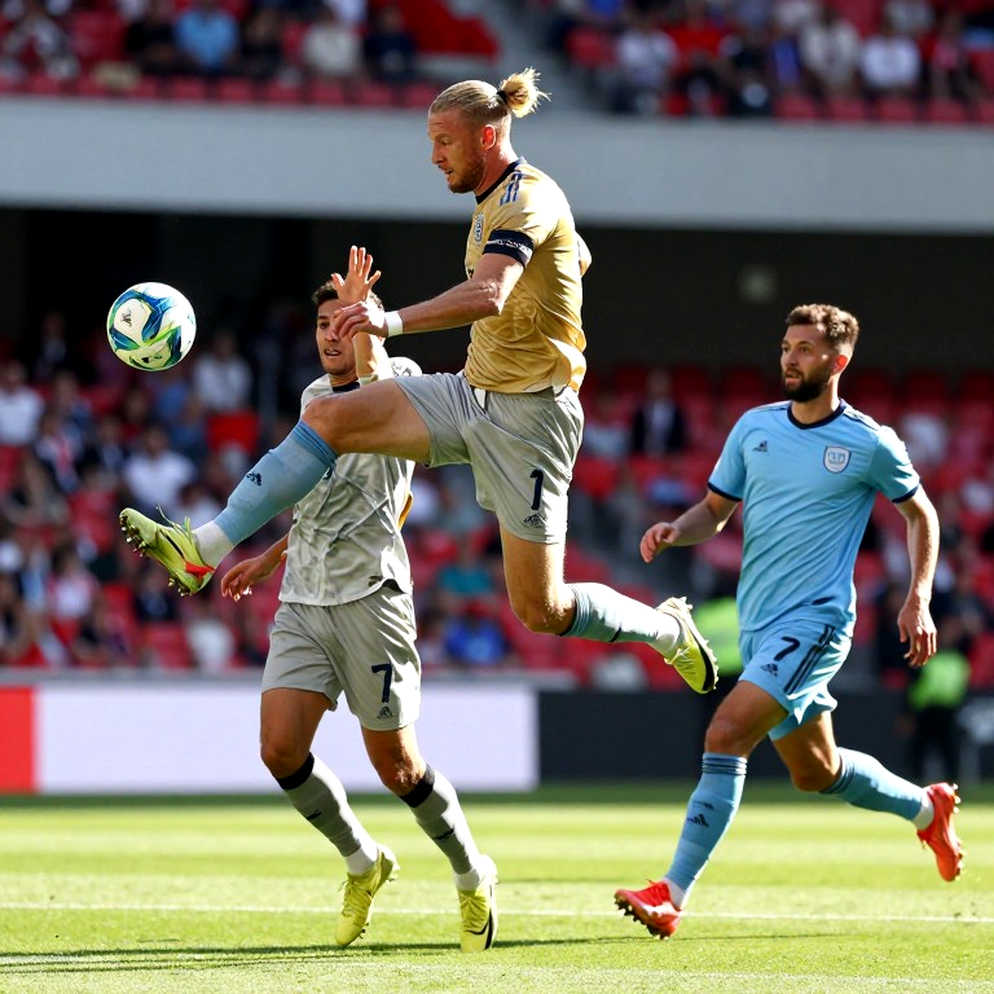
And availability. The injury record is absent from every listed point, while the publicly reported record includes a long foot problem and a long-term knee injury — external facts, to be verified, but their absence is itself a signal. A 29-year-old aggressive centre-back who needs maximum physical coverage is an availability risk. Asking a returning player to prove himself is already cruel; loading him with a high line and lone defending is the next page of that cruelty.
What the outside sees, and what is actually happening
The common reading is: United lack ambition, so a serious player is looking at a project like Barcelona. The sentence is attractive and almost unfalsifiable — impossible to prove wrong, impossible to prove right. No named source said it, no club confirmed it. Its actual function is to shift reputational cost from the player onto the club.
My reading runs the other way. The most likely outcome here is not that Martinez joins Barcelona; it is that he signs improved terms at United. At 29, in the final contract year, a player has exactly one real objective: securing his last significant deal. Publicly signalling unhappiness is the oldest reliable method, whether the destination is Barcelona, Atletico, or simply a better offer at United.

Hence the question every deal should be asked: who benefits from this leak? A fee-bearing January transfer generates commission; a free summer transfer shifts that value into the player's signing bonus. The party that gains from the fee-bearing version is the party best placed to put the story into the market in exactly this shape. That is the cleanest industrial explanation of why this story exists at all.
And the place where the headline looks most wrong: Atletico Madrid may be a better footballing destination than Barcelona. A more conservative, compact structure protects a front-foot defender's aggression and masks his recovery limitations. A report treating Atletico as a nuisance should have treated them as the better functional match.
The signals I will keep watching
If you want a conclusion from this, take it from four concrete signals rather than the headline. First, the contract option status at United — confirmed, and the story is worth zero. Second, renewal briefings at United — positive ones mean the story has already done its job. Third, Barcelona's cap headroom and the state of their existing left-sided centre-back — until that slot opens, the interest is paper. Fourth, Martinez's return to the pitch and his minutes load — the only number that lowers the risk discount and raises the price.
Spanish coverage has an old pattern: first a player is framed as ideal for the coach, and if he arrives and cannot handle the physical demands of a high line, the same ecosystem calls him an expensive mistake. The article writing 'new home' today is the opening move of that cycle, not a neutral report.
So read it in the language of contract dates and ledgers. Whose pocket the fee leaves, where the amortisation lands, who frees the cap space — that is the real scoreline. And until those numbers surface, I will stay in the empty stand until they switch the floodlights off, because an empty seat is still a witness, and I write down what it saw.